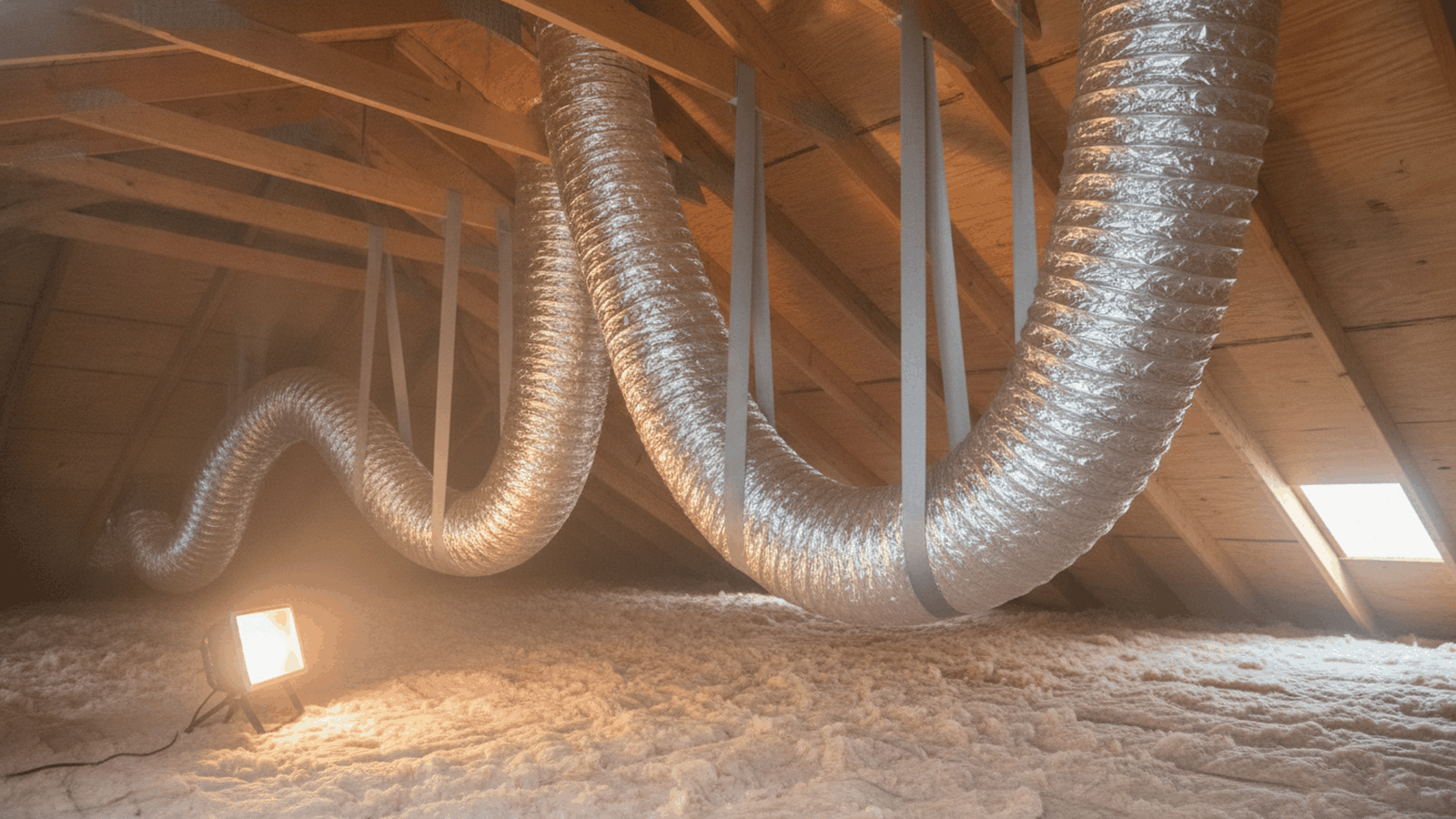
The published national numbers for duct replacement cost don’t agree, and they aren’t close. This Old House puts a full job at less than $2,000 to more than $8,000. Homewyse lists $13.95 to $23.19 per linear foot as of May 2026. Today’s Homeowner says $450 to $2,200. Thumbtack says $393 to $1,421. The gap isn’t sloppy research. It’s scope, and none of those figures is a Tampa Bay quote.
What controls duct replacement cost?
Size, access, material, and insulation move the number more than anything else does.
This Old House prices the work by the linear foot at $16 to $19, and it works a 200 foot example out to roughly $3,100 to $3,700. That same guide puts small, straightforward projects under $2,000 and says a large or complex system can run past $8,000. Homewyse uses the per foot model too, and its May 2026 national estimate lands at $13.95 to $23.19 a foot.
Then the whole-job sources come in far lower. Today’s Homeowner publishes $450 to $2,200 for basic installations in accessible areas, with most homeowners paying about $1,250. Thumbtack reports $393 to $1,421 nationally, most people paying near $735, with outer bounds of $164 and $3,449.
Don’t blend those into one average. They aren’t describing the same job.
Why do national estimates disagree so much?
The per foot sources are pricing a complete system. The low whole-job numbers are usually pricing partial or easy-access work.
Run the arithmetic and it stops being mysterious. Two hundred feet at $16 to $19 is $3,200 to $3,800, which tracks This Old House’s own $3,100 to $3,700 example closely. Today’s Homeowner’s entire range tops out at $2,200. That ceiling sits below This Old House’s floor for the same 200 feet, so the two can’t be describing the same amount of finished ductwork.
Material choice adds another layer. This Old House lists non-insulated flexible duct at $1 to $3 per foot, insulated flexible at $2 to $4, fiberboard at $4 to $7, and sheet metal at $7 to $15. Those are material prices, not installed prices, and the difference between them is a big part of why finished totals spread out the way they do.
Access matters too. This Old House names hard-to-reach areas, insulation requirements, and complex layouts as the things that push a quote up, and it puts permit fees anywhere from under $100 to several hundred dollars depending on where you are.
All of that is useful as a reference point. Your quote still has to come from someone who measured your house.
What do Tampa Bay duct numbers actually look like?
We’ve published two Tampa Bay ductwork figures already, and they sit at opposite ends of the scale because they describe completely different jobs.
Our new AC cost guide for Tampa Bay says that sealing or replacing sections of attic ductwork can add anywhere from $1,500 to $6,000, depending on how much needs work. That’s partial work done alongside an equipment replacement, which is why it lands near the low end of the national whole-job ranges rather than near the per foot math.
At the other end, our guide to mini splits in older Tampa homes puts a full ductwork retrofit plus central AC at $15,000 to $30,000 and up, depending on how much structural modification the retrofit takes. That’s running ducts into a house that never had them, with the equipment included, so it isn’t comparable to a duct-only quote either.
Neither number is the price of replacing an existing whole-house duct system, and you can’t split the difference to get there. What they’re good for is placing your own quote: if it looks nothing like either one, the scope is probably different from what you think it is, and that’s the question to ask.
What makes a Tampa Bay duct job different?
Florida attics are brutal on ductwork, so insulation and access carry more weight here than a national average assumes.
A Tampa Bay attic in July regularly hits 130 to 150 degrees. The air moving through the duct is sitting near 55. That’s an 80-plus degree difference across a thin wall of insulation, and our cooling season runs about nine months, so the ducts live in that condition most of the year.
Sweating ducts follow from the same physics, and they’re a distinctly Florida failure. Humid attic air meets a cold duct surface and condenses on it. Return-side leaks make it worse in a different way, because they pull attic air into the system, and that air carries dust, fiberglass particles, and in older homes remnants of blown-in insulation.
None of that sets a local price. It does explain why the insulation line on your quote deserves a careful read.
What does Florida code require for replacement ductwork?
Replacement ductwork isn’t grandfathered. It has to meet the current requirements.
The governing document is the Florida Building Code, Energy Conservation, 8th Edition (2023). Section R503.1.2 covers alterations, and it says new duct systems installed as part of an alteration have to comply with the R403 requirements. There’s a narrow exception, and it’s worth knowing what it actually covers: it applies where ducts from an existing system are extended, and only where less than 40 linear feet runs through unconditioned space. That’s an extension rule. A full replacement doesn’t qualify for it.
Here’s what R403.3.1 asks for. Supply and return ducts in an attic have to be insulated to at least R-8 where they’re 3 inches in diameter or greater, and R-6 below that. Ducts running elsewhere in the building get R-6 at 3 inches and up, and R-4.2 below that. Since most Tampa Bay duct runs live in a vented attic, R-8 is the number that usually applies to your house.
One more rule catches older homes. The code says framing cavities can’t be used as ducts or plenums, which is exactly what a panned return in a mid-century house often is.
Does Florida require duct leakage testing?
On the prescriptive path, yes. The code marks duct testing as mandatory.
Section R403.3.3 says ducts have to be pressure tested to determine air leakage. The post-construction method measures total leakage across the entire system, including the air handler enclosure, at a 0.1 inch w.g. pressure differential, with the registers taped or otherwise sealed. The pass line in R403.3.4 is 4 cubic feet per minute per 100 square feet of conditioned floor area.
There’s a real exception, and it’s the one worth asking about. No leakage test is required where the ducts and air handlers sit entirely inside the building thermal envelope. A vented Florida attic isn’t inside that envelope, which is why the test usually does apply around here.
Not just anyone can run it, either. The code points to individuals defined in Florida Statutes 553.993(5) or (7), or licensed under 489.105(3)(f), (g), or (i). Florida’s code also offers more than one compliance path, and duct testing isn’t separately mandatory on the performance path, so it’s fair to ask which path your project is being permitted under.
How should I read a duct replacement quote?
A good quote tells you four things: the insulation, the testing, the scope, and the permitting path.
Start with the R-value written on the page. If the ductwork is going in the attic, compare what’s quoted against the code minimums for its diameter. If part of the run is inside the house, the minimums there are different, and the quote should reflect that.
Next, look for duct leakage testing. Ask whether it’s in the quoted scope, who performs it, and whether you get the result in writing.
Then ask how many linear feet are included and whether this is a complete or partial replacement. That single answer is what lets you compare a real quote against the national ranges above without fooling yourself. Ask which duct material is included, and whether removal and disposal of the old ductwork is in there too.
If a quote bundles ductwork with another repair, ask to see the two scopes separately. Our evaporator coil replacement cost guide walks through why component pricing needs its own comparison.
What are the permit rules in Hillsborough County?
In unincorporated Hillsborough County, ductwork is mechanical work, and mechanical work is handled differently from minor repairs.
The county’s non-structural permit exemption doesn’t apply when the work includes electrical, plumbing, structural, mechanical, or gas work, and it also doesn’t apply once the value of work reaches $7,500. Its mechanical no-permit list is narrower still. It covers replacement of a part that doesn’t alter its approval or make it unsafe, and a whole duct system isn’t a single part.
The county makes that call, not us. The licensed contractor pulls whatever permit the county requires.
There’s a second threshold worth knowing about. A Notice of Commencement is required on a project needing only a mechanical permit when the project cost hits $15,000 or more. A whole-house duct replacement can get within range of that, where a single-component repair never will.
All of this applies to unincorporated Hillsborough County. Tampa, St. Petersburg, Clearwater, and Pasco run their own permitting. If you’re inside the city, our Tampa HVAC service page is the place to start.
Should I seal the ducts or replace them?
Sealing is the cheaper path whenever the existing system is still worth keeping, and it often is.
Sealing goes after the leaks without tearing out every run. Our guide to duct sealing in Florida attics covers that path in detail, including what the work actually involves up in the heat.
Replacement enters the conversation when repairs can’t save what’s up there. The crews we work with will look at the accessible portions of the system and lay out both options honestly, including what each one leaves you with.
If the ducts are structurally fine and the real complaint is debris or dust, that’s a different job. Professional duct cleaning handles that, and persistent comfort or humidity problems may point toward indoor air quality options instead. When replacement is genuinely the answer, start with ductwork repair and replacement. Tampa Air Pro matches homeowners with licensed pros across Hillsborough, Pinellas, and Pasco, with 24/7 emergency service available.
Should I replace ducts with a new AC system?
Quote the ductwork and the equipment separately, even when you’re doing both at once.
Our new AC cost guide for Tampa Bay owns the full-system side of this. It publishes $5,500 to $9,500 installed for a straight AC system in a typical 1,600 to 2,400 square foot Tampa Bay home, and that price covers a new outdoor condenser, a matching indoor air handler or coil, standard line set connections, permit fees, and disposal of the old equipment.
What it doesn’t cover is new ductwork. So if you’re weighing both, ask the pro to break equipment and ductwork into separate lines. That’s the only way to see what each decision is really costing you, and it makes the do-it-now versus do-it-later question much easier to answer.
Homeowners looking at the equipment side can read up on AC installation services. To get matched with a local pro, send the details through our contact page.
Frequently asked questions
How much does duct replacement cost?
Published national estimates run from $393 to more than $8,000, and the spread comes down to scope: partial versus full systems, material, and how hard the ductwork is to reach. A quote worth comparing states the linear footage and the insulation it includes.
What does duct replacement cost per foot?
This Old House publishes $16 to $19 per linear foot nationally, and Homewyse publishes $13.95 to $23.19 as of May 2026. Neither one is a Tampa Bay quote, and neither includes what your specific attic will demand.
Why are some duct replacement estimates so much lower?
Lower estimates usually describe partial or easy-access work rather than a whole system. Two hundred feet at This Old House’s $16 to $19 comes to $3,200 to $3,800, which is more than Today’s Homeowner’s entire published ceiling of $2,200. Compare the scope before you compare the totals.
Does Florida require R-8 attic duct insulation?
Yes, for attic ducts 3 inches in diameter and greater; smaller attic ducts require R-6. Those minimums come from Section R403.3.1 of the Florida Building Code, Energy Conservation, 8th Edition (2023).
Does replacement ductwork require a leakage test?
On the prescriptive path it does, unless the ducts and air handlers sit entirely inside the building thermal envelope. A vented Florida attic isn’t inside that envelope, so the test usually applies here. Florida also offers a performance compliance path that treats testing differently, so ask which one your job is following.
Does duct replacement require a permit in Hillsborough County?
That’s the county’s call. Unincorporated Hillsborough’s non-structural exemption doesn’t apply to mechanical work, and its mechanical no-permit list only reaches replacing a part that doesn’t alter its approval or make it unsafe. A licensed contractor pulls the permit when the county requires one.