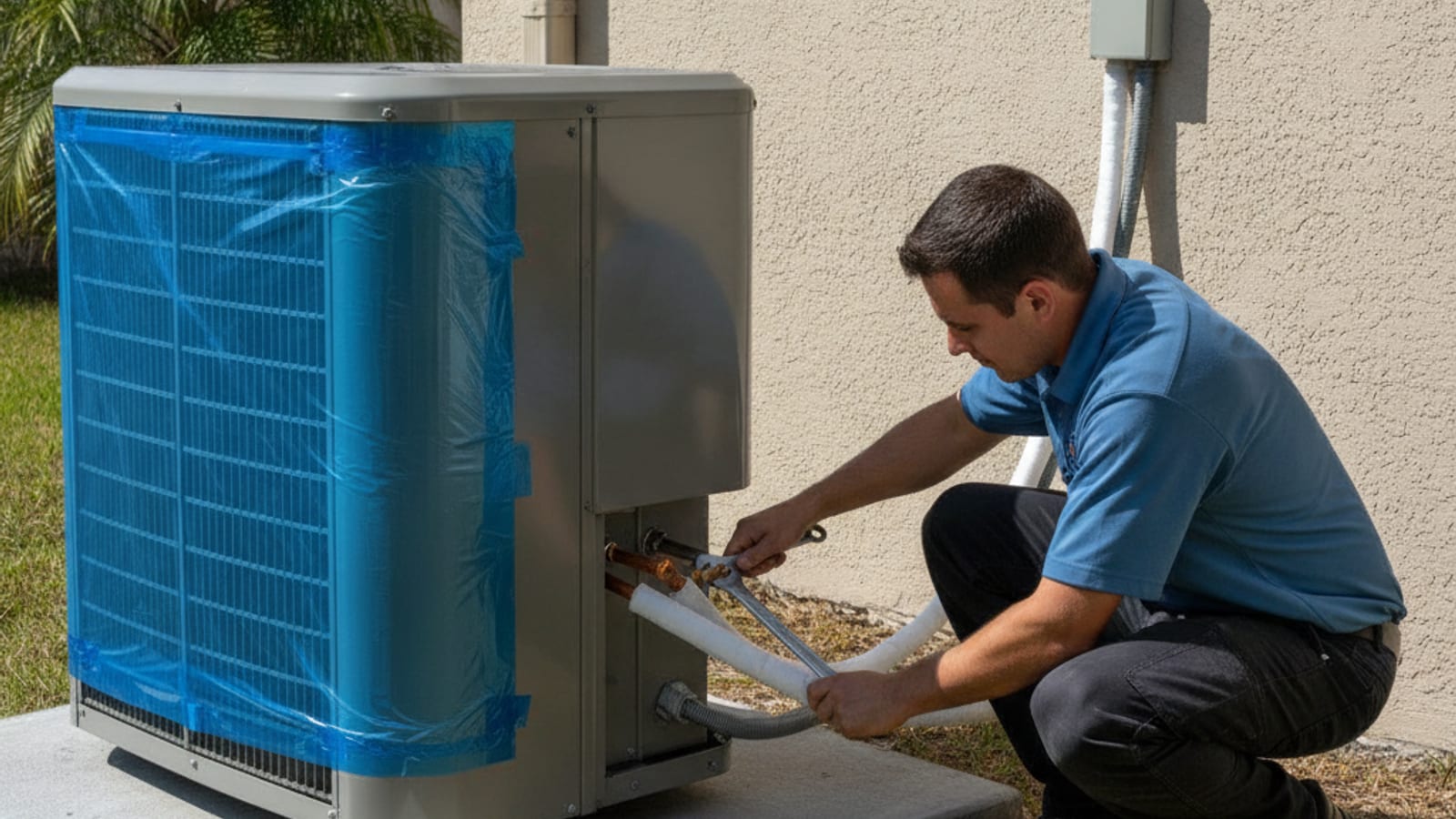
Nobody replaces an AC system for fun. It’s usually a decision made in July, with a dead unit, a hot house, and a number on an estimate that feels bigger than expected. So let’s get specific about what Tampa Bay homeowners are actually paying in 2026, and what pushes that number up or down.
The baseline range for a straight AC swap
For a typical 1,600 to 2,400 square foot Tampa Bay home, replacing a straight AC system, meaning a standard split system without heat pump function, generally runs $5,500-$9,500 installed. That covers a new outdoor condenser, a matching indoor air handler or coil, standard line set connections, permit fees, and disposal of the old equipment.
Where you land in that range depends on tonnage, efficiency rating, and brand. A 2-ton system for a smaller home in Seminole Heights or Gulfport costs less than a 4-ton system needed for a larger home in New Tampa or Wesley Chapel. Higher SEER2 ratings, the current federal efficiency standard that replaced the older SEER metric, cost more upfront but lower monthly electric bills, which matters in a climate where the AC runs nearly year-round.
Heat pump systems cost more, but do more
A heat pump system swaps the standard condenser for one that can reverse and provide heating in addition to cooling. In Tampa Bay’s climate, where true furnace heat is rare and most homes rely on heat pumps or electric strip heat for the handful of cold snaps each winter, a heat pump replacement typically runs $6,500-$12,000 depending on tonnage, efficiency tier, and whether the air handler needs replacing too.
The upfront premium over a straight AC system usually lands somewhere between $1,000 and $3,000, and it buys you a system that heats efficiently on the nights temperatures drop into the 30s and 40s, which happens most winters in the Tampa Bay area. If you’re weighing the two, Heat pump or straight AC: what Florida homes actually need breaks down which one fits your situation.
What pushes a quote higher
Ductwork condition. If your ducts are original to a home built during the 1978 to 1995 boom years common in Brandon, Riverview, and parts of Land O’ Lakes, there’s a real chance they’re leaking, crushed, or undersized for a modern system. Sealing or replacing sections of attic ductwork can add anywhere from $1,500 to $6,000 depending on how much needs work. A contractor who skips inspecting the ducts and just swaps the equipment is setting you up for a system that never performs the way it should.
Electrical and pad work. Older homes sometimes need an updated disconnect box or a new condenser pad, especially if the home has settled or the existing pad has cracked. This is usually a smaller add, in the $200 to $600 range, but it shows up more often than homeowners expect.
Attic access and second-story installs. Homes with air handlers in tight attic spaces or second-floor closets take longer to service, and that labor time shows up in the estimate. Tampa’s older two-story homes in areas like Hyde Park and Davis Islands see this more than newer single-story construction further out in Pasco County.
Permit and inspection fees. Every legitimate HVAC replacement in Hillsborough and Pinellas counties requires a permit, and that cost is typically built into your quote rather than billed separately. Be wary of any bid that skips permitting to save money. It’s not worth the risk if you ever sell the home.
Mini-splits for older, no-duct homes
Tampa Bay has a meaningful stock of pre-1960s homes, especially in neighborhoods like Ybor City, South Tampa, and parts of St. Petersburg, that were never built with central ductwork. For these homes, ductless mini-split systems are often the more practical and less invasive option. A single-zone mini-split for one room or addition runs roughly $4,000-$6,500 installed. A multi-zone system covering a whole home can run $12,000-$20,000 or more, depending on how many zones and the total square footage.
Mini-splits also make sense as a targeted fix for additions, garage conversions, or Florida rooms that the main system was never sized to handle, without the cost of extending ductwork into a space that wasn’t designed for it.
Financing and rebates: what’s real right now
The federal 25C energy efficiency tax credit that used to apply to qualifying HVAC upgrades expired for installs completed after December 31, 2025. If a salesperson quotes you a specific rebate or tax credit dollar amount as though it’s guaranteed, ask for it in writing and confirm it directly with the utility or program administrator before you count on it. Local utility rebate programs do exist in the Tampa Bay area and change frequently, so the honest move is to confirm whatever’s currently available at quote time rather than relying on last year’s numbers.
Most contractors also offer financing plans that spread the cost over 12 to 60 months. Interest rates and terms vary enough that it’s worth comparing more than one option before signing.
If a storm is what put you in the market, check the policy before you count on it. Our guide to whether homeowners insurance covers AC replacement in Florida explains why a percentage hurricane deductible can absorb the whole replacement, and how long Florida law gives you to file.
What’s included versus what gets billed separately
A complete, honest quote should spell out exactly what’s covered. Equipment and standard installation labor are the baseline. Beyond that, ask specifically whether the price includes a new condenser pad if the existing one is cracked or undersized, a new disconnect box if the current one doesn’t meet code for the new equipment’s amperage, line set replacement or flush if the existing lines are being reused, and startup testing with refrigerant charge verification once the system is running. A quote that’s noticeably cheaper than others is sometimes cheaper because it’s leaving out one or more of these, and they show up as change orders once the crew is already on site.
It’s also worth asking what warranty coverage applies to both parts and labor, and for how long. Manufacturer warranties on equipment typically run 10 years if registered properly, but labor warranties vary a lot by contractor, from one year to ten. A lower upfront price paired with a short labor warranty can end up costing more if something needs attention two or three years in.
Timeline for a typical replacement
A straight AC or heat pump swap in an existing home with functional ductwork usually takes one full day, sometimes finishing by early afternoon if the crew starts early and the site is straightforward. Jobs that involve ductwork repairs, electrical upgrades, or attic access complications can stretch into a second day. Permitting adds time on the front end in most cases, since Hillsborough and Pinellas counties both require an approved permit before work begins on most residential HVAC replacements, though many contractors handle that paperwork as part of the process rather than leaving it to the homeowner.
If your system fails completely during peak summer heat, ask about emergency or expedited scheduling. Most established HVAC companies in the Tampa Bay area keep some flexibility in their schedule for genuine no-cool emergencies, though exact wait times shift depending on how many other households are dealing with the same thing during a heat wave.
Comparing multiple quotes without getting overwhelmed
Getting two or three quotes is standard advice for a reason, but comparing them apples to apples takes more than looking at the bottom-line number. Match tonnage, SEER2 rating, and brand tier across quotes before comparing price, since a lower number attached to a smaller or less efficient unit isn’t actually the better deal. Ask each contractor the same specific questions, particularly around Manual J load calculations and what ductwork inspection, if any, is included in the quoted price. The contractor who takes the time to actually walk your attic and explain their reasoning is usually the one worth trusting with a five-figure decision, even if their number isn’t the lowest one on the table.
Getting an accurate quote
The biggest cost variable isn’t the equipment. It’s whether the contractor actually sizes the system correctly for your home using a real load calculation, rather than just matching whatever tonnage is already there. An oversized or undersized system, installed cheap, ends up costing more over its lifetime in energy bills and premature repairs than a properly sized system installed right the first time.
We connect Tampa Bay homeowners with experienced, insured HVAC crews for AC installation quotes that account for your home’s actual ductwork, square footage, and sun exposure, not just a generic tonnage guess. If you’re deciding between a straight system and a heat pump, get quotes on both before you commit. The right call depends on your home, your ductwork, and how you actually use heat during Tampa’s short but real winter.