A restaurant on the losing end of a July AC breakdown isn’t dealing with an inconvenience. It’s dealing with a health code problem, a walk-in cooler under strain, and customers walking back out the door within minutes. Commercial AC in Tampa Bay carries a different risk profile than residential, and business owners who treat it the same way they’d treat a home system usually find that out at the worst possible time.
Why commercial systems in Tampa run harder than residential ones
A home AC cycles on and off across a day depending on occupancy and outdoor temperature. A commercial system in a retail space, restaurant, or office in this climate is often running near-continuously for 10-14 hours a day, every day, for nine months of the year, sometimes longer if the business also has kitchen equipment or server rooms generating extra heat load. That’s a fundamentally different duty cycle, and it means commercial equipment needs to be sized and maintained with a much smaller margin for error than a residential system carries.
Businesses along the Westshore business district, downtown Tampa, and the retail corridors of Clearwater and Largo all deal with this same baseline reality: Florida commercial cooling load doesn’t ease up the way it does in most of the country, and equipment selected without accounting for that runs into premature failure faster than owners expect.
Rooftop units vs. split systems for commercial spaces
Most commercial buildings in Tampa Bay use one of two setups:
Packaged rooftop units (RTUs)
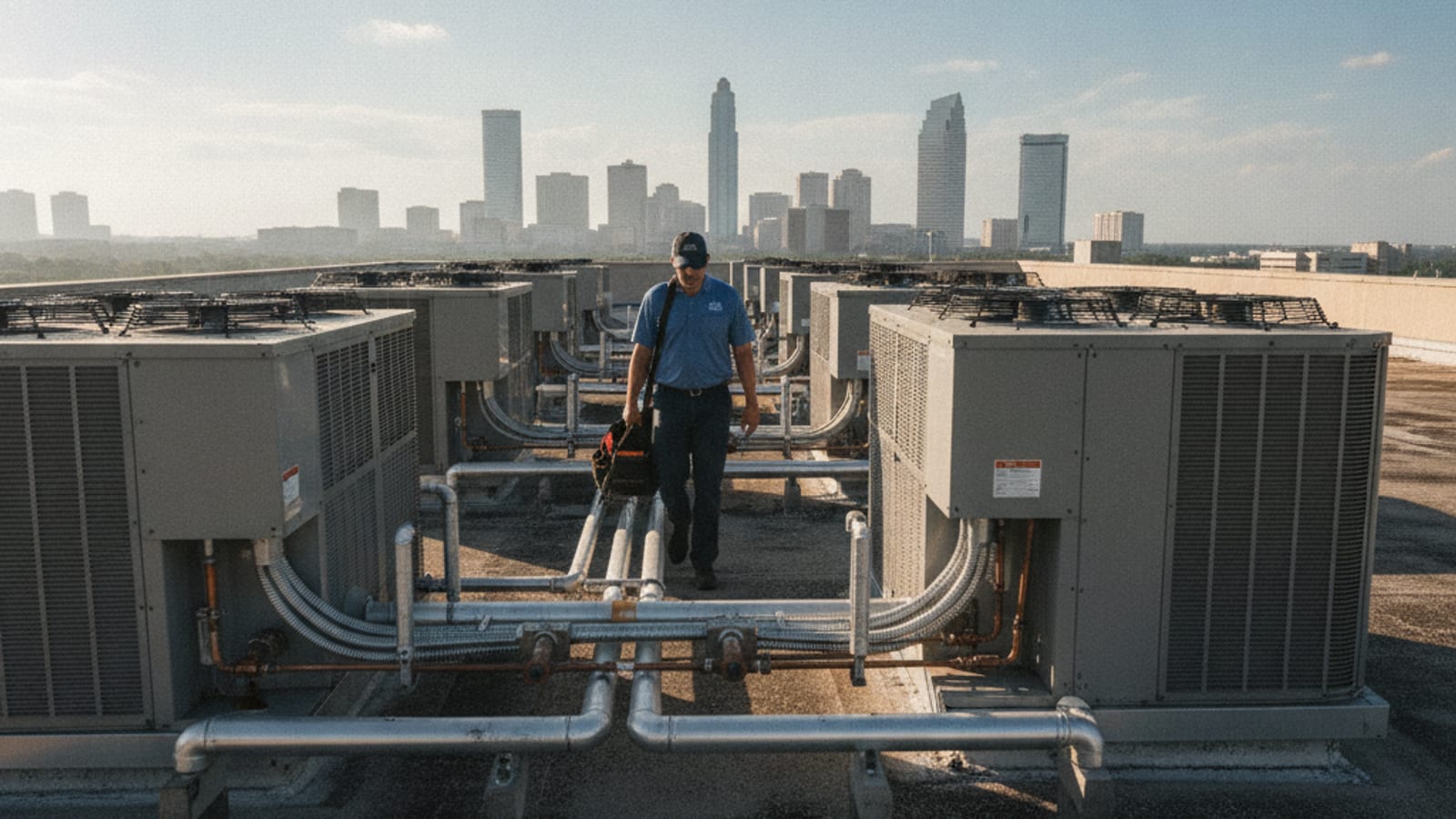
The most common choice for retail spaces, restaurants, and single-story commercial buildings. Everything, compressor, coils, and air handling, sits in one unit on the roof, which simplifies maintenance access and keeps mechanical equipment out of interior space. Rooftop units in Florida are exposed to intense sun, salt air near the coast, and heavy afternoon storm activity, all of which accelerate wear on the cabinet, coil, and electrical components compared to a sheltered installation.
Split systems
More common in office buildings and multi-tenant spaces where zoning matters, since a split system setup can serve multiple areas with independent temperature control more easily than a single rooftop unit. Installation is more involved than a straightforward RTU swap, but the flexibility often pays off for buildings with varied occupancy patterns across different zones.
The right choice depends heavily on the building’s layout, roof access, and whether different areas need independent temperature control. A commercial hvac provider should walk through both options with actual load calculations for your specific space rather than defaulting to whatever’s fastest to install.
Sizing: the mistake that costs the most over time
Undersized commercial systems in Tampa Bay struggle constantly and never quite catch up on hot afternoons. Oversized systems cycle too fast, which means they satisfy the temperature setpoint before pulling enough humidity out of the air, a problem that shows up as a business that feels cold but still smells slightly damp. Both mistakes cost money for the life of the equipment, not just at installation.
A proper load calculation for a commercial space accounts for square footage, but also occupancy patterns, kitchen or equipment heat load, window exposure, and ceiling height, all of which vary enormously between, say, a retail storefront in Hyde Park Village and a warehouse space in Ybor City. Sizing based on square footage alone, without those factors, is one of the most common and expensive mistakes in commercial installs.
What downtime actually costs
For a restaurant, AC failure isn’t just discomfort. Florida health code has real temperature thresholds for food storage and prep areas, and a prolonged cooling failure can force a closure until it’s resolved. For retail, a hot storefront in July drives customers back out the door within minutes, and foot traffic lost during a breakdown doesn’t fully come back once the AC’s fixed. For office space, productivity and employee retention both take a hit during extended discomfort, something owners tend to underweight until they’ve lived through it once.
This is the core argument for a maintenance contract over a break-fix approach: the cost of a missed maintenance visit is never just the maintenance fee, it’s the downtime risk that visit was meant to catch early.
Maintenance contracts vs. reactive repair
Commercial hvac maintenance contracts typically run quarterly for businesses in this climate, more frequent than the twice-yearly schedule that works for most residential systems, given the heavier duty cycle commercial equipment carries here. A quarterly contract for a mid-sized commercial space generally runs $400-$1,200 a year depending on system size and number of units, and it typically includes coil cleaning, refrigerant checks, electrical component testing, and filter changes on a schedule that matches actual runtime rather than a generic calendar.
Compare that to the cost of a single emergency compressor failure during peak season, commonly $6,000-$15,000+ for commercial-grade equipment depending on system size, on top of the revenue lost during the outage itself, and the math on a maintenance contract becomes straightforward for most business owners once they’ve run the comparison honestly.
Energy costs and commercial system age
Commercial AC systems installed before roughly 2015 often run on older refrigerant and lower-efficiency compressor technology compared to current SEER2-rated equipment. For a business running a system 10-14 hours a day, the efficiency gap between an aging unit and current equipment compounds fast across a Tampa Bay cooling season, and a lot of business owners are surprised how quickly a system upgrade pays for itself in reduced electric costs once the math is actually run against their specific usage hours, not a generic estimate.
Questions worth asking a commercial provider
- What’s the actual duty cycle assumption behind this sizing recommendation, and does it account for our specific occupancy and equipment load
- What’s included in a quarterly maintenance visit versus what counts as a separate repair call
- What’s the manufacturer warranty on commercial-grade equipment, and does it require using a specific certified installer to stay valid
- What’s the realistic timeline for parts and repair if this specific unit fails during peak summer demand
Backup planning for critical commercial spaces
For businesses where an AC outage carries especially high stakes, restaurants with walk-in coolers, medical offices, server rooms, data-sensitive operations, it’s worth having a documented backup plan beyond just a maintenance contract. That can mean a service agreement with guaranteed response time during a failure, a relationship with a provider who stocks common commercial parts locally rather than ordering on demand, or in some cases a secondary portable cooling unit kept on hand for critical rooms during a repair window. None of this replaces good maintenance, but it limits how bad a worst-case scenario actually gets when a failure happens anyway, which it eventually will on any piece of mechanical equipment given enough runtime.
New construction and build-out considerations
Business owners building out a new space or taking over an existing commercial unit should treat HVAC sizing as part of the build-out planning from day one, not an afterthought handled after the layout is finalized. A kitchen build-out, a server room addition, or even a change in expected occupancy from the previous tenant can shift the cooling load significantly from what the existing system was designed for. Bringing a commercial provider in during the planning phase, rather than after equipment is already installed, avoids the expensive scenario of discovering a system is undersized only after the business has opened and is already dealing with the consequences during a hot Tampa summer.
How long does commercial AC installation typically take?
For a standard rooftop unit replacement on an existing commercial building, installation usually takes 1-3 days depending on unit size and whether ductwork modifications are needed. Larger multi-unit installs or split system builds for multi-zone office space can take longer, generally a week or more, and should be scheduled around business hours or off-peak days where possible to limit disruption.
Does a commercial system need a different type of technician than residential?
Commercial HVAC work generally requires additional certification and experience beyond standard residential licensing, particularly for larger rooftop units and more complex multi-zone systems. It’s worth confirming a provider has specific commercial experience rather than assuming residential HVAC skills transfer directly, since load calculations, equipment types, and code requirements differ meaningfully between the two.
What’s a realistic lifespan for commercial AC equipment in this climate?
Well-maintained commercial rooftop units in Tampa Bay’s climate typically last 12-18 years, somewhat shorter for coastal-adjacent buildings given the same salt exposure issues that affect residential coastal systems. Consistent quarterly maintenance tends to land equipment life at the higher end of that range rather than the lower end.
The bottom line for Tampa Bay business owners
Commercial AC in this climate isn’t residential AC scaled up. It runs harder, fails under higher stakes, and rewards a proactive maintenance approach far more than the break-fix habit a lot of businesses fall into by default. The businesses that avoid a summer shutdown aren’t the ones with better luck. They’re the ones on a maintenance schedule built around their actual usage.
Call (813) 000-0000 and we’ll connect you with an experienced, insured commercial provider who can walk your space and give you real numbers before your system tells you it’s time the hard way.