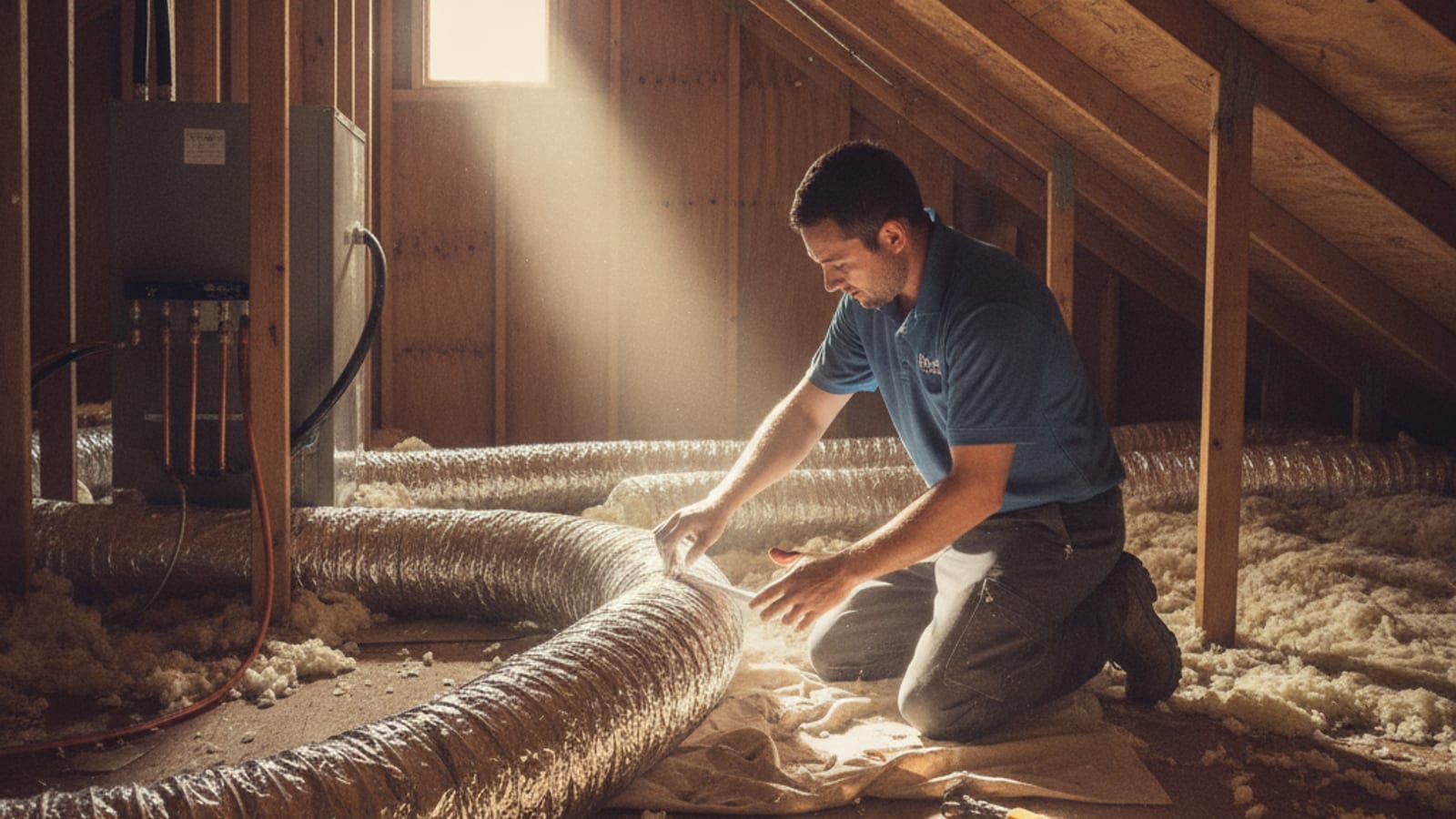
Your AC works fine at the unit and the air coming out of the vents still isn’t cold. Or a room at the far end of the house never quite cools down no matter what the thermostat says. Both point to the same overlooked culprit: the ductwork running through your attic, which in Tampa’s climate is one of the hardest working, least inspected parts of the entire system.
Why Florida attics are brutal on ductwork
A Tampa Bay attic in July regularly hits 130 to 150 degrees during peak afternoon heat. Your ductwork runs directly through that space, carrying air that’s been cooled to somewhere around 55 degrees on its way to the supply vents. That’s an 80-plus degree temperature difference between the inside of the duct and the air surrounding it, and that gap is exactly what causes two separate but related problems.
Condensation, or “sweating” ducts. When cold air inside a duct meets a gap or thin spot in the insulation wrapping it, moisture in the surrounding humid attic air condenses on the outside of the duct, the same way a cold glass of iced tea sweats on a summer porch. Over time, that condensation drips onto attic insulation, saturates it, and can eventually stain ceiling drywall below or, in bad cases, contribute to mold growth in the attic space itself. This is a distinctly Florida problem. Drier climates rarely see it, because the humidity that makes it happen isn’t there.
Heat gain through the duct walls. Even without visible sweating, heat constantly moves from the hot attic air into the cooler air inside the ductwork, warming the air before it ever reaches your rooms. Ductwork with thin, aged, or gapped insulation loses a meaningful percentage of its cooling capacity to the attic before that air completes its trip to the vent.
Leaky ducts pull hot, humid attic air in
Heat gain through the duct wall is one problem. Actual air leaks are a bigger one. Ductwork is typically built from sections joined together with mastic sealant, tape, or mechanical fasteners, and all of those connection points degrade over years of Florida’s heat cycling the ducts hot during the day and cooler at night. Once a seam separates or a connection loosens, two things can happen depending on which side of the duct system it’s on.
On the supply side, cooled air escapes into the attic before it reaches the room, meaning your system is paying to cool air that never does its job. On the return side, the system pulls in replacement air from wherever it can find it, and if that’s a leaky attic connection, it’s pulling in hot, humid, dusty attic air and mixing it straight into the air circulating through your home. Homes in older neighborhoods built during Tampa’s 1978 to 1995 growth years, common in Brandon, Riverview, and Town ‘N’ Country, are especially prone to this since original ductwork from that era is now decades past its expected lifespan.
The energy bill tells the story
Duct leakage studies across humid climates consistently find that a meaningfully leaky duct system can lose a substantial share of conditioned air before it ever reaches a vent, which shows up as a system running longer and harder to hit the same setpoint. If your electric bill has crept up over the past couple of summers without a clear reason, and your system seems to be working harder for the same result, duct leakage is worth ruling out before assuming the AC unit itself is failing.
How duct sealing actually works
A technician doing a proper duct evaluation checks insulation coverage, looks for visible gaps, disconnections, and crushed sections, and in more thorough evaluations may run a duct blaster test to measure actual air leakage as a percentage. Sealing typically uses mastic sealant applied directly to seams and joints, which holds up far better over time than standard tape, which tends to dry out and peel in Florida’s heat and humidity cycles within a few years.
Sections of ductwork that are too degraded to seal, crushed from storage boxes stacked on top of them, or simply undersized for the system’s airflow needs sometimes need outright replacement rather than repair. This is more common in homes where the original ducts were sized for an older, smaller system and never upgraded when a bigger AC was installed later.
Insulation choices that actually hold up in Florida attics
Not all duct insulation performs the same way in a hot, humid attic. Standard fiberglass duct wrap can lose effectiveness over time if it compresses, shifts, or gets damaged by anyone walking through the attic for other repairs, like cable or plumbing work. Higher R-value wrap, typically R-6 or R-8 for supply ducts in a climate like Tampa Bay’s, holds up better and reduces the heat gain problem described earlier, though it costs more upfront than thinner, lower-rated wrap. For ducts that run through especially hot sections of an attic, such as near the roof ridge, upgrading to a higher R-value during a sealing or repair project is often worth the added cost given how much time that ductwork spends sitting in triple-digit heat.
Rigid metal ductwork and flexible ducting, sometimes called flex duct, respond differently to sealing work too. Flex duct, common in newer Tampa Bay construction, has an inner liner, a layer of insulation, and an outer vapor barrier, and damage or gaps in any one of those three layers creates a different kind of problem. A technician sealing flex duct needs to address the specific layer that’s compromised, not just wrap more insulation around the outside and call it fixed.
The connection between ductwork and indoor air quality
Leaky return ducts don’t just waste conditioned air. They pull whatever is floating around in the attic, dust, fiberglass particles, and in older homes sometimes even remnants of blown-in insulation, directly into the air circulating through your living spaces. Homeowners dealing with unexplained dust buildup, allergy symptoms that seem to track with how hard the AC is running, or a persistent musty smell from the vents sometimes trace the issue back to return-side duct leaks rather than anything wrong with the air handler or filter itself. Sealing those leaks addresses the comfort and energy problems described above, and it often improves indoor air quality as a side effect, since the system stops pulling attic air into the mix in the first place.
What homeowners can check without going in the attic
A few signs point to duct problems even from ground level: rooms that are consistently warmer than others, especially rooms at the far end of ductwork runs or above garages; visible water stains on ceilings that appear during or right after peak cooling season; a musty smell coming from vents; and a noticeable gap between what the thermostat reads and how the house actually feels. Any one of these on its own could have another cause, but together they’re a strong signal worth having checked.
How often duct sealing needs revisiting
Duct sealing isn’t a one-time, permanent fix in a climate that puts this much thermal stress on a system year after year. Mastic-sealed joints generally hold up well for a decade or more, but flex duct connections, insulation jackets, and any repair work done with lower-quality materials can degrade faster, particularly in the hottest sections of an attic near the roofline. Having ductwork checked as part of routine seasonal maintenance, roughly every one to two years, catches new leaks or insulation damage before they turn into the kind of comfort and energy problems described above. This is especially worth building into a maintenance routine after any other attic work, like re-roofing, insulation additions, or electrical or plumbing repairs, since ductwork gets bumped, stepped on, or shifted more often during those projects than homeowners realize.
Getting it fixed right
Duct sealing and repair isn’t a glamorous fix, but it’s one of the higher-value improvements available for Tampa Bay homes with attic ductwork, both for comfort and for the electric bill. A system that’s cooling great at the unit but losing 20 to 30 percent of that cooling before it reaches the rooms is never going to perform the way its rating suggests, no matter how new or efficient the equipment is.
We connect Tampa Bay homeowners with experienced, insured HVAC crews for duct cleaning and ductwork repair that starts with an actual inspection of your attic ductwork, not a guess based on the age of the house. If your system feels like it’s working harder than it should for a house that still isn’t quite comfortable, the ducts running through that hot attic are one of the first places worth checking.