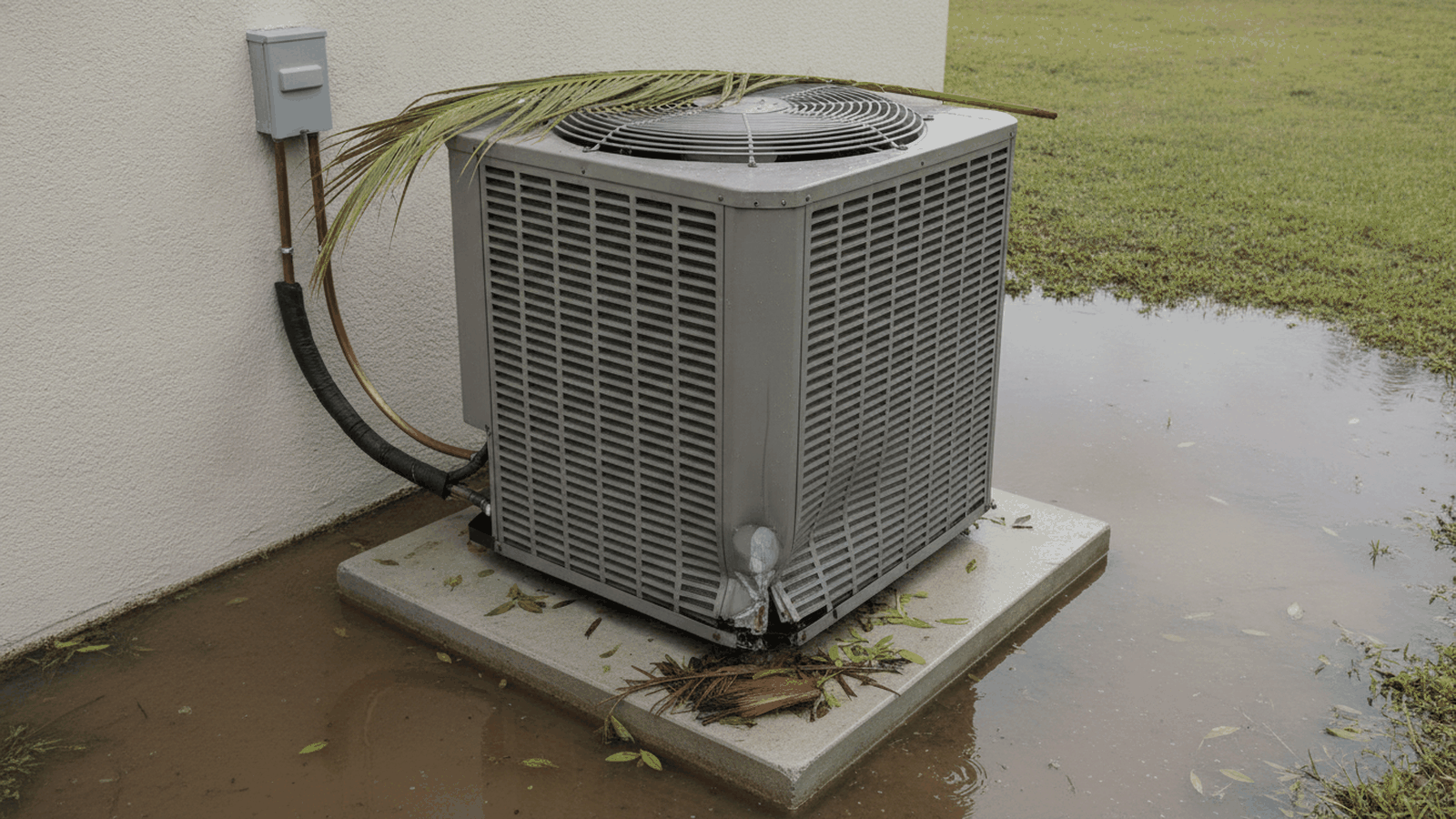
Homeowners insurance covers an AC replacement when a covered peril destroys the equipment. It doesn’t cover a system that simply wore out, aged out, or failed mechanically. That’s where most national guides stop, and in Florida it’s only half the story. Here the deductible and the notice deadline can decide whether a covered loss pays anything at all, so check both before you assume a claim is worth filing.
Does homeowners insurance cover AC replacement?
It can, but only when your policy covers the event that damaged the equipment, and only when a written diagnosis ties that event to the failure. Both halves have to be there.
So the cause comes first. A condenser flattened during a covered event is a different conversation than an aging compressor that quits on a Tuesday afternoon. Age, corrosion, wear-and-tear, and ordinary mechanical failure all sit on the maintenance side of that line, and no amount of documentation moves them across it.
That line gets blurry along the bay, which is where the confusion usually starts. Salt air chews through outdoor equipment fast, and our guide to coastal AC corrosion in Tampa Bay walks through how it happens. Corrosion explains why a unit died. It doesn’t make the death a covered loss. Your policy decides that.
Use this framework before opening a claim:
| What happened | First question to ask | Practical next step |
|---|---|---|
| Equipment failed after a hurricane | Does the policy cover this cause, and which deductible applies? | Check the declarations page and request a written HVAC diagnosis |
| Equipment failed after another sudden event | Is that event covered under the policy? | Compare the documented damage with the all-other-peril deductible |
| The system aged out or broke mechanically | Is there a covered event connected to the failure? | Discuss AC repair or replacement options |
| A ground-level condenser was flooded | Does separate flood coverage apply? | Contact the insurer or agent before assuming coverage |
Visible storm damage doesn’t settle the question on its own. The policy language, the deductible, the documented cause, and the notice date all have to line up.
What does homeowners insurance actually cover on an AC unit?
It covers the AC only when the policy covers the cause of the damage. Routine equipment failure doesn’t become an insured loss just because the repair bill is large.
There are really three questions, and it helps to keep them apart:
- What caused the failure?
- Does your policy cover that cause?
- Is the covered amount bigger than the deductible that applies?
A licensed HVAC pro answers the first one. Your insurer answers the other two. Tampa Air Pro doesn’t make coverage decisions and doesn’t adjust claims, and no HVAC company can tell you over the phone that insurance will cover it.
Keeping those roles straight saves people real money. A system can need full replacement and still produce nothing payable. It can also carry event-related damage that has to be documented before anyone touches it.
If the unit’s repairable, weigh that against professional AC repair service first. If it’s replacement, get the scope in writing before you look at AC installation options.
What is my deductible on an AC claim in Florida?
It’s whatever number is printed on your policy, not a statewide default. Florida law controls what insurers have to offer you. Your declarations page records what you actually took.
For personal lines residential property policies, Florida Statute 627.701 requires insurers to offer hurricane deductibles equal to $500, 2 percent, 5 percent, and 10 percent of the policy dwelling limits. Read that carefully, because it’s an offer requirement and nothing more. It doesn’t mean your policy carries a 2 percent deductible, and it doesn’t mean your neighbor’s does either.
There’s one wrinkle worth knowing before you go looking. Once the dwelling limit hits $250,000 or more, the insurer no longer has to offer the flat $500 hurricane option at all. Where that option isn’t offered, what’s left is a percentage of the dwelling limit.
Citizens Property Insurance shows the two categories side by side about as clearly as anyone. Its HO-3 Coverage Worksheet lists hurricane deductible options of $500, 2 percent, 5 percent, and 10 percent of Coverage A, and all-other-peril options of $500, $1,000, and $2,500. One is a slice of your dwelling limit. The other is a flat dollar amount that doesn’t move with your coverage.
Those are Citizens options, not statewide policy terms, and Citizens says plainly that the worksheet doesn’t interpret anybody’s policy. Your rights come from your own policy.
Here’s why the percentage is the whole ballgame. Say a home carries a $400,000 dwelling limit with a 2 percent hurricane deductible. Two percent of $400,000 is $8,000.
Now put a real replacement price next to it. Our Tampa Bay AC replacement cost guide puts a straight AC system at $5,500 to $9,500 installed for a typical 1,600 to 2,400 square foot Tampa Bay home, meaning a standard split system without heat pump function.
Line those up and the problem is obvious. On an AC-only loss, that $8,000 deductible can swallow most or all of the replacement. Other covered damage on the same claim and your specific policy terms change the math, so this isn’t a verdict on your situation. It is a reason to find the deductible before you count on insurance paying for a new system.
Where do I find my own hurricane deductible?
It’s on your declarations page, in dollars. Florida law requires the insurer to calculate the actual dollar value of the hurricane deductible and prominently display it there when the policy is issued, so you shouldn’t have to do the percentage math yourself.
And if the policy carries a separate hurricane deductible, its face has to carry this warning:
THIS POLICY CONTAINS A SEPARATE DEDUCTIBLE FOR HURRICANE LOSSES, WHICH MAY RESULT IN HIGH OUT-OF-POCKET EXPENSES TO YOU.
Look for these items together:
- The Coverage A or dwelling limit
- The hurricane deductible percentage
- The hurricane deductible’s calculated dollar value
- The all-other-peril deductible
- Any endorsements changing the policy terms
Florida law says the hurricane deductible applies annually to covered hurricane losses during the calendar year. That annual rule applies specifically to hurricane losses and carries additional statutory conditions. Ask your insurer or agent how earlier hurricane claims during the same year affect your policy.
How long do I have to file an AC damage claim in Florida?
You must give the insurer notice within one year after the date of loss. Under Florida Statute 627.70132, the property claim is barred if notice isn’t given within that period and according to the policy’s terms.
Read that as a notice deadline, not a repair deadline. Nobody’s asking you to have the new system installed inside a year. They’re asking you to have told the insurer.
A supplemental claim gets 18 months instead. The statute defines it narrowly: additional loss from the same peril on a claim the insurer already adjusted. It isn’t a second shot at a claim you never filed in the first place, and a reopened claim still runs on the one-year clock. The statute also says none of this changes the separate deadline for bringing a civil action, which is its own subject.
Here’s the part that catches people out, and almost nobody writes it down. For hurricane damage, the date of loss is the date the hurricane made landfall. It is not the day you finally noticed the condenser was dead. If the failure turns up three weeks after the storm, three weeks of your year are already gone.
Give notice the way your policy tells you to. All of this is general information about Florida deadlines, not legal advice about your claim.
Why did the insurance company only send part of the money?
Because a replacement-cost dwelling claim is designed to pay in stages. Florida law requires the insurer to pay at least the actual cash value of the loss first, less the deductible, and that first check is supposed to look small.
Under Florida Statute 627.7011, the rest of the replacement-cost money comes as the work is performed and the expenses are incurred. So the gap between the first payment and the approved scope isn’t necessarily a lowball. It can simply be the sequence.
One condition matters a lot here. This applies when the dwelling loss is insured on a replacement-cost basis, and that coverage isn’t automatic. Florida law frames it as something the insurer has to offer unless the policyholder turns it down in writing.
If your policy is written at actual cash value instead, it pays depreciated value and that’s the end of it. Check the declarations page and the endorsements before you treat a first payment as the final number.
Keep the HVAC diagnosis, the approved scope, the invoices, and the proof of payment in one place. Then ask the adjuster what they need to see before each stage releases.
What about flood damage to an AC condenser?
Flood is its own review, and it’s the case worth slowing down for. A ground-level condenser sits right in the path of rising water, and homeowners coverage and flood coverage are not the same product.
Our guide to AC preparation during Tampa hurricane season flags this exact split. Whether flood damage to that condenser falls under a standard policy or needs separate flood insurance varies by policy and by insurer, and that’s a question for your agent rather than your HVAC tech.
What you can do right away is photograph the standing water and the equipment before anyone cleans up. Then ask the insurer or agent which policy should get the notice. Don’t let the look of the condenser decide the cause for you.
What should I do when the AC dies after a storm?
Document everything, then call the insurer. Clear photos and a written diagnosis are what separate storm damage from ordinary equipment failure once an adjuster gets involved, and they’re much harder to produce a week later.
Work through these in order:
- Photograph the outdoor unit, indoor equipment, and surrounding property.
- Capture standing water before cleanup if flooding occurred.
- Record the system’s model, serial number, and visible condition.
- Ask the insurer what notice and documentation it requires.
- Request a written HVAC diagnosis identifying the failed component.
- Get separate repair and replacement recommendations when both are possible.
Don’t ask an HVAC company whether the policy covers it. The technician diagnoses the equipment, and that’s a genuinely useful document. The insurer interprets the policy and adjusts the claim, and that’s a different job.
If the house has no cooling at all, that’s a 24/7 emergency HVAC service call. The pros in our network can inspect the system and write down what they find while the evidence is fresh. Homeowners around Clearwater and Tampa Bay can start from the local service page.
Once the emergency’s handled, regular HVAC maintenance keeps a paper trail on the system’s condition and catches the mechanical problems that sit outside a covered loss in the first place.
Frequently asked questions
Does homeowners insurance cover AC replacement?
Yes, when a covered peril causes the damage and the policy terms support replacement. It doesn’t cover an AC that simply aged out, wore out, or failed mechanically. The deductible may also absorb part or all of an AC-only loss.
Does homeowners insurance cover an AC that just stopped working?
Not when the system stopped solely because of age, wear-and-tear, or ordinary mechanical failure. If a sudden event may have caused the failure, get a written diagnosis. Your insurer then decides whether that cause is covered.
What is a hurricane deductible?
A hurricane deductible is the amount applied to covered hurricane losses under the policy. It may be expressed as a percentage of the dwelling limit. Florida insurers must display the calculated dollar value on the declarations page.
How long do I have to file an AC damage claim in Florida?
You have one year from the date of loss to give the insurer notice according to the policy. For a hurricane, the loss date is the landfall date. The deadline concerns notice, not completion of repairs.
Will filing an AC claim raise my insurance premium?
Your carrier or agent must answer that question for your policy. We won’t predict a premium change or apply a statewide percentage to an individual claim. Ask how the loss could affect premium or renewal before deciding whether to proceed.
Does insurance cover a lightning-damaged AC?
It may when the policy covers the event and the diagnosis connects lightning to the failure. Lightning can damage AC control boards and capacitors. The insurer still determines coverage, applies the deductible, and reviews the documentation.
Tampa Air Pro matches homeowners with licensed HVAC pros across Hillsborough, Pinellas, and Pasco counties. Emergency service is available 24/7. If your system needs a diagnosis, repair, or replacement estimate, contact Tampa Air Pro to request help.