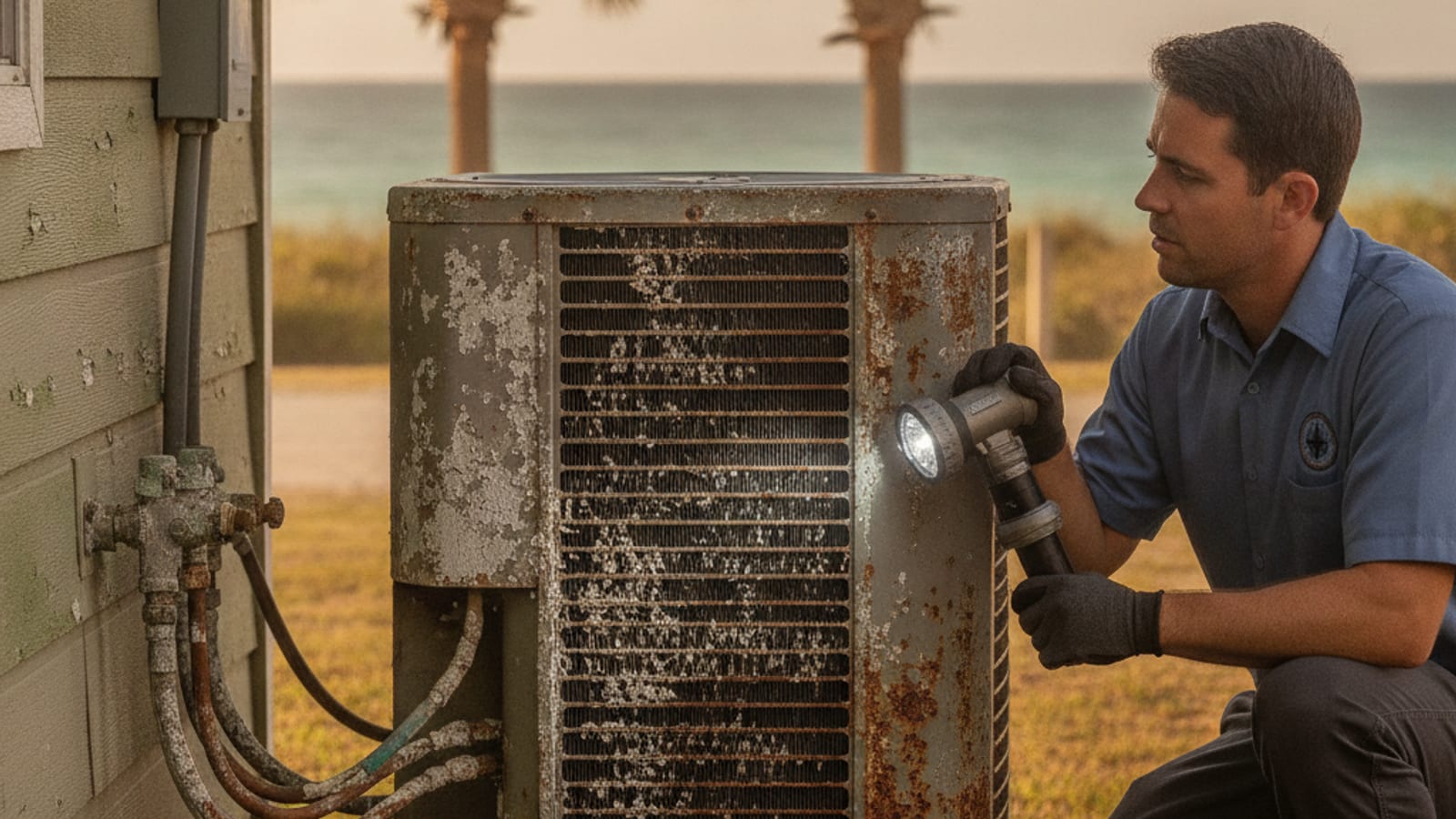
Ask any HVAC technician who works St. Pete Beach, Treasure Island, or Indian Rocks Beach and they’ll tell you the same thing: condensers out here don’t last as long as the ones ten miles inland. A unit that would run 12-15 years in Carrollwood or Wesley Chapel can be corroded and struggling by year seven or eight on Gulf Boulevard. It’s not a coincidence, and it’s not bad luck. It’s salt.
What salt air does to a condenser coil
An outdoor AC condenser’s job depends on a coil made of thin aluminum fins wrapped around copper tubing, designed to move heat as efficiently as possible. That efficiency depends on thin metal and a lot of exposed surface area, which is exactly the combination that corrodes fastest in a salt-laden environment.
Salt-laden sea breeze carries microscopic salt particles that settle on the coil constantly, day and night, whether or not there’s a storm. Combined with Tampa Bay’s humidity, that salt doesn’t just sit there. It draws moisture out of the air and creates a mildly corrosive film on the aluminum fins. Over months and years, that film pits and thins the metal, and eventually it eats through fin material entirely, reducing the coil’s ability to shed heat. A corroded coil forces the compressor to work harder to hit the same cooling output, which shortens compressor life on top of the coil damage itself.
You can usually see it before a technician even opens the cabinet. Condensers on Madeira Beach or Clearwater Beach properties often show a white, chalky residue on the coil fins, sometimes with visible pitting or a greenish tint on copper components, well before units of the same age further inland show any wear at all.
How much faster do coastal units actually fail
There’s no single number that applies to every home, since exposure depends on distance from the water, prevailing wind direction, and how sheltered the unit is. But the general pattern HVAC techs see across the barrier islands and immediate coastline, think Treasure Island, Tierra Verde, Belleair Beach: units within a quarter mile of open water often need coil replacement or full condenser replacement 4-7 years earlier than a comparable unit in Brandon or New Tampa. Homes right on the water, especially ones without any wind buffer from adjacent structures or landscaping, sit at the aggressive end of that range.
Signs your coastal unit is corroding
Watch for these, especially if your home is within a mile or two of the Gulf or the bay:
- Cooling capacity that’s noticeably weaker than it used to be, even after a fresh filter
- Ice forming on the refrigerant line or coil during normal operation
- Visible white or grayish crust on the outdoor unit’s fins
- Rust starting to show on screws, the cabinet, or the base pan
- Higher electric bills for the same amount of cooling, a sign the compressor is working harder to compensate
If you’re seeing two or more of these, it’s worth having a technician check the coil directly rather than waiting for a full breakdown, particularly during peak summer when ac repair appointments book up fast.
What actually slows the corrosion down
None of this is fully preventable if you live on the water, but the rate can be slowed considerably with the right choices.
Coastal-rated equipment
Some manufacturers make units with factory-applied protective coatings on the coil, sometimes called “coastal armor” or e-coat finishes, specifically designed to resist salt corrosion. These units cost more upfront, generally $500-$1,500 more than a standard residential condenser, but for a beach-adjacent property the math usually works out, since it can meaningfully extend the unit’s usable life before major coil failure.
Rinsing the unit regularly
A simple garden-hose rinse of the outdoor coil every 2-4 weeks, gently, with the power off, removes accumulated salt film before it has time to pit the metal. This is the cheapest and most effective thing a coastal homeowner can do, and it’s the one most people skip.
Placement and wind buffering
If you’re installing a new system, positioning the condenser away from direct onshore wind, or behind a fence, wall, or dense landscaping that blocks the worst of the salt spray, meaningfully cuts exposure. This isn’t always possible on a small beach lot, but where it is, it matters.
More frequent professional service
Coastal units benefit from maintenance visits every four months instead of the standard twice-a-year schedule inland homeowners typically use. A technician can catch early corrosion, clean the coil properly with a coil cleaner rather than just a hose rinse, and check refrigerant charge before a degraded coil forces the compressor into overwork.
Replacing a corroded system
When a coastal unit’s coil is too far gone to save, replacement is usually the more cost-effective path over another coil-only repair, since a badly corroded coil is often a sign the cabinet and other components aren’t far behind. A straightforward coastal condenser swap, unit plus labor, typically runs $4,500-$8,500 depending on system size and whether ductwork or the indoor air handler also needs attention. It’s worth asking specifically about ac installation options built for salt exposure rather than defaulting to a standard inland unit, since the price difference is small relative to how much sooner a standard unit will need replacing again in the same location.
Hurricane season adds another layer
Coastal exposure isn’t the only thing shortening equipment life along the Gulf. Salt-corroded electrical connections and cabinet screws are more vulnerable to storm-related damage than clean ones, since corrosion weakens the metal and hardware a technician relies on to reseal or replace parts quickly after a storm. Hurricane season, June through November, overlaps almost entirely with the corrosion-prone months when salt exposure is highest, which is part of why coastal units in places like Treasure Island and St. Pete Beach see a higher combined failure rate than the salt exposure alone would explain. Wind-driven rain and storm surge flooding are a bigger risk to a coastal condenser than to an inland one, since a coil that’s already thinned by corrosion has less margin left before storm damage pushes it into full failure.
What a technician actually checks during a coastal inspection
A proper coastal-focused inspection goes beyond the standard maintenance checklist. Along with the usual filter, refrigerant, and electrical checks, a technician working a Gulf-facing property should specifically evaluate the coil fin condition under magnification if needed, check the base pan and cabinet screws for early rust that can spread to structural fasteners, and test the contactor and capacitor for the resistance changes that salt-related corrosion tends to cause earlier than in inland units. If your regular HVAC company isn’t calling out these coastal-specific checks by name, it’s worth asking directly whether they’re being done.
How often should a coastal AC unit really be serviced?
Every four months is the general recommendation for homes within a mile or two of open water, compared to the twice-yearly schedule that works fine inland. The extra visit is specifically there to catch coil corrosion and connection issues before they compound during peak summer demand.
Does a protective coil coating void the manufacturer warranty?
Factory-applied coastal coatings from the manufacturer don’t void the warranty, since they’re built into the unit at the point of sale. Aftermarket coatings applied after installation can affect warranty terms depending on the manufacturer, so it’s worth confirming with whoever installs the coating before assuming it’s covered the same way.
Is it worth moving a condenser away from the water side of the house during a replacement?
If the property layout allows it, yes. Even a modest amount of distance and a wind buffer, a fence, wall, or dense shrubs, meaningfully cuts salt exposure compared to a unit sitting in direct onshore wind. It won’t eliminate the problem on a barrier island, but it slows it down.
The bottom line for coastal Tampa Bay homeowners
If your AC lives within a mile or two of open water, salt air is working against it every single day, not just during storms. A rinse routine, the right equipment choice, and a slightly tighter maintenance schedule won’t stop corrosion completely, but they buy real years. If your unit is already showing white residue or weaker cooling, don’t wait for a full breakdown in August to deal with it.
Call (813) 000-0000 and we’ll connect you with a local pro who works coastal systems regularly and can tell you honestly whether your coil needs cleaning, coating, or replacement.