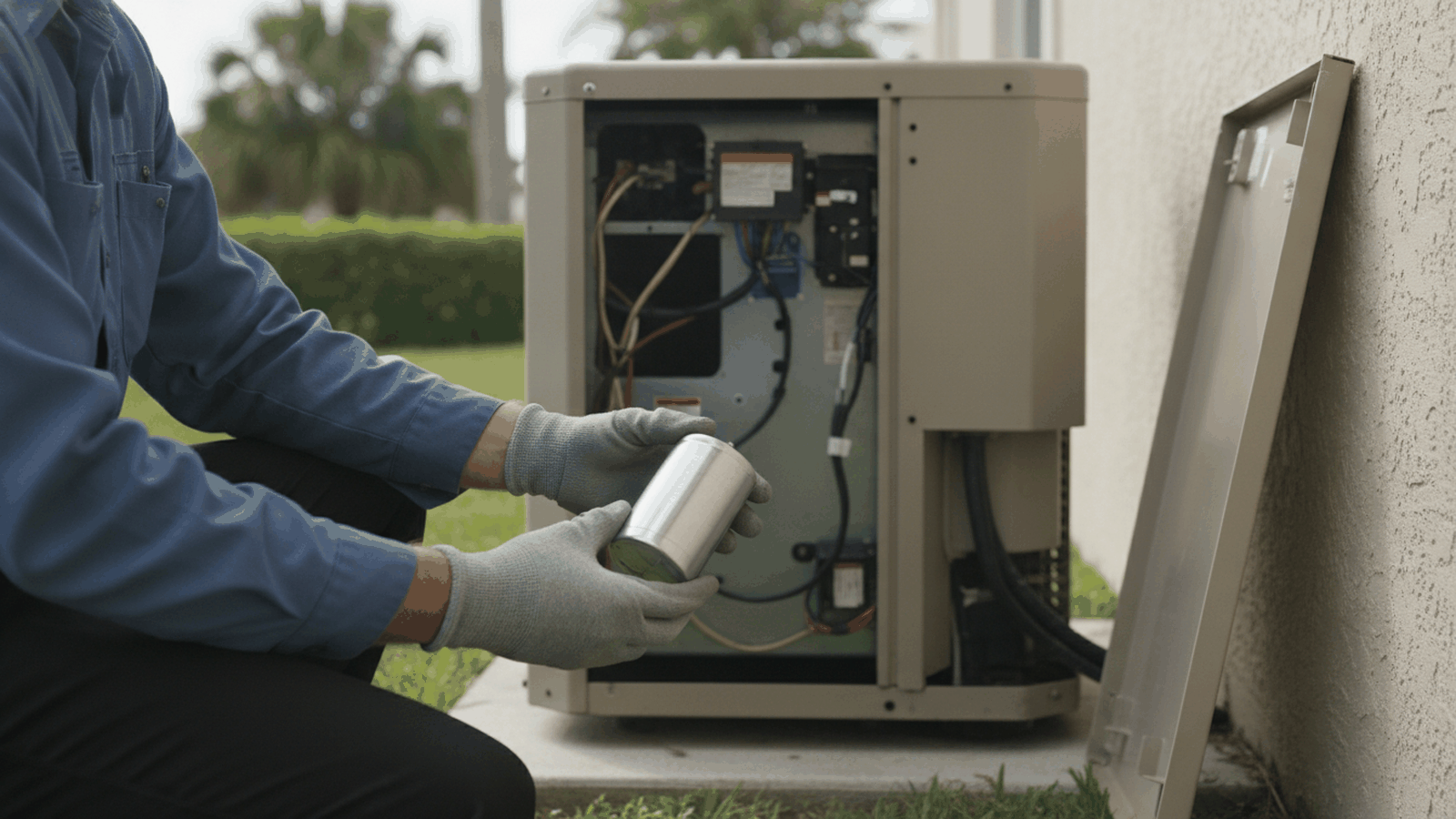
Published national figures put professional AC capacitor replacement cost between roughly $100 and $400. Carrier and Bryant each publish $100 to $400. HomeAdvisor reports a $180 national average and says most homeowners spend $200 to $400. Your Tampa Bay price still depends on the diagnosis, part, labor, and system access.
What does AC capacitor replacement cost?
Published prices differ because each source frames the work differently, so there’s no single honest Tampa Bay average to point at. Here’s what three established national sources publish:
| Source | Published national figure | What the figure covers |
|---|---|---|
| HomeAdvisor | $180 average | Professional capacitor replacement |
| HomeAdvisor | $200 to $400 | What most homeowners spend |
| HomeAdvisor | $8 to $45 | The capacitor part alone |
| HomeAdvisor | $300 to $600 | All-inclusive rates, including the capacitor |
| Carrier | $100 to $400 | The part and professional installation |
| Carrier | $75 to $150 per hour | Technician labor |
| Bryant | $100 to $400 | Professional capacitor replacement |
The clearest summary is that published national figures cluster between roughly $100 and $400. HomeAdvisor places most professional jobs between $200 and $400.
HomeAdvisor also publishes a $300 to $600 all-inclusive range. That figure includes the capacitor’s cost. Its separate part-only range runs from $8 to $45.
These numbers aren’t quotes from Tampa Air Pro. They also aren’t guaranteed Tampa Bay prices. A local quote should follow an actual system diagnosis.
That distinction matters because a no-cool call isn’t automatically a capacitor problem. A technician must identify the failed component before pricing the correct repair.
What changes the final capacitor replacement price?
The capacitor itself may represent only part of the repair. Diagnosis, labor, system access, and related faults can affect the final quote.
The capacitor type and rating
Air conditioners don’t all use the same capacitor, and the replacement has to match the equipment’s required type and rating. Some systems run one capacitor for multiple components, while others use separate capacitors for different motors.
The time required for diagnosis
A stopped outdoor unit can point toward several possible faults, so the technician may need to test the capacitor and the components it serves. That testing separates the failed part from the symptom, and it keeps a working capacitor from being replaced for nothing.
Carrier publishes technician labor between $75 and $150 per hour. That is a national figure, not a Tampa Air Pro rate.
Access around the outdoor unit
Clear equipment access keeps inspection and testing straightforward, while tight clearances or obstructed panels make the visit more involved. You can help by keeping stored items clear of the unit.
Problems beyond the capacitor
A weak or failed capacitor isn’t always the only fault, and the connected motor, control board, wiring, or compressor may need evaluation too. When the blower motor itself is the failure, our hvac blower motor replacement cost guide covers that repair. That doesn’t mean every capacitor failure signals a larger breakdown, just that the quote should match the diagnosed problem.
For a system that isn’t cooling, start with professional AC repair in Tampa Bay. The HVAC pros we send can determine which component needs attention.
Why do capacitors fail in Tampa Bay?
Tampa Bay air conditioners work through long stretches of heat and humidity. Frequent cooling cycles repeatedly call on the capacitor and connected motors.
A capacitor helps a motor start or continue running. When its performance weakens, the motor may struggle or stop operating.
Florida thunderstorms create another local concern. Lightning strikes during frequent summer storms can damage control boards and capacitors outright.
That combination gives Tampa Bay homeowners a practical reason to recognize common symptoms. It doesn’t prove the capacitor has failed, but it helps frame the service call.
Regular HVAC maintenance can give a technician an opportunity to inspect system operation. Maintenance can’t prevent every electrical component failure.
Our guide to an AC not cooling during a Tampa summer covers other common causes. It can help you describe the problem before requesting service.
What are the signs of a failing AC capacitor?
A failing capacitor can affect how the outdoor unit starts or runs. The symptoms can overlap with several other AC problems.
Common observations include:
- The outdoor unit doesn’t start when cooling begins.
- The fan stops while the system is calling for cooling.
- The system tries to start but cannot remain running.
- Air moves indoors, but the home doesn’t cool properly.
- The outdoor equipment operates inconsistently between cooling cycles.
These signs aren’t a complete diagnosis. Similar symptoms can come from controls, motors, wiring, or the compressor.
A technician can test the capacitor rather than relying on appearance alone. The part’s required rating should also match the equipment specifications.
When cooling stops outside regular hours, 24/7 emergency HVAC service is available. Coverage includes Hillsborough, Pinellas, and Pasco counties.
When is it the capacitor and when is it the compressor?
A capacitor supports motor operation, while the compressor moves refrigerant through the system. Problems with either component may keep the outdoor unit from running correctly.
From the homeowner’s side the symptoms look nearly identical: the outdoor unit stops, struggles to start, or fails to cool.
That overlap makes testing important. Replacing the capacitor without confirming the fault can leave the original problem unresolved.
A technician can check the capacitor against its required rating, then watch how the connected motor responds.
The decision should follow those findings:
| Diagnostic finding | Likely direction |
|---|---|
| Capacitor fails testing, connected component operates normally | Replace the correct capacitor |
| Capacitor tests correctly, but a motor doesn’t operate | Continue diagnosing the motor and controls |
| New capacitor doesn’t restore proper operation | Investigate another system fault |
| Several major components have problems | Compare repair needs with replacement context |
A capacitor quote shouldn’t quietly become a compressor conclusion. Each component needs its own diagnosis.
Do you need a permit to replace an AC capacitor in Florida?
A straight capacitor replacement generally doesn’t require its own permit under the Florida Building Code. Section 105.2 includes this mechanical exemption: “Replacement of any part that does not alter its approval or make it unsafe”.
The exemption doesn’t remove the code’s other requirements. The same section says, “Exemptions from permit requirements of this code shall not be deemed to grant authorization for any work to be done in any manner in violation of the provisions of this code”.
In practical terms, the permit exemption and code proviso work together. Replacing a minor part may be exempt, while the completed work must still comply with applicable code.
That distinction applies to a straightforward part replacement. Broader system alterations shouldn’t be treated as the same job.
Can you replace an AC capacitor yourself?
Hiring a qualified HVAC professional is the sensible path for diagnosis and replacement. A capacitor must match the system, and similar symptoms can have different causes.
Florida also regulates air-conditioning contracting for hire. Florida Statutes 489.113(2) states, “A person must be certified or registered in order to engage in the business of contracting in this state”.
Florida’s Class B air-conditioning contractor definition covers contracts involving central air-conditioning installation, maintenance, and repair. Those services require the experience, knowledge, and skill described in Florida Statutes 489.105(3)(g).
Tampa Air Pro is a referral service, not the contracting licensee. We match homeowners with licensed HVAC pros serving the Tampa Bay area.
A homeowner shouldn’t hire an unlicensed person for paid AC repair. The HVAC pro should diagnose the failure and install the correct component.
When does repair make more sense than replacement?
A confirmed capacitor failure can be a focused repair. The broader system condition still affects the homeowner’s decision.
Consider repair when the capacitor is the isolated diagnosed problem. The technician should also confirm the connected component operates correctly.
Replacement enters the conversation when the system has wider problems. Age, repeated failures, and major component faults may shape that discussion.
For context, a straight AC system replacement generally runs $5,500 to $9,500 installed for a typical 1,600 to 2,400 square foot Tampa Bay home. Our Tampa Bay AC replacement cost guide explains that separate decision.
That system price shouldn’t be used to inflate a capacitor repair. It simply shows why an accurate diagnosis matters before discussing replacement.
A good service conversation keeps the choices distinct. First identify the failed part. Then compare only the options supported by that diagnosis.
What should happen during a capacitor service visit?
The visit should start with your reported symptoms, since clear details help the technician pin down when the failure occurs.
Useful observations include whether the indoor blower runs and whether the outdoor fan or compressor tries to start.
The technician can then inspect and test the relevant components. That process should confirm whether the capacitor matches the symptoms.
If replacement is appropriate, the new capacitor must match the equipment’s requirements. The technician should then verify system operation after installation.
Before authorizing work, ask what the diagnosis showed. Also ask whether the quoted amount covers the complete capacitor replacement.
These questions keep the conversation focused:
- Did the capacitor fail testing?
- Which motor or component does it serve?
- Does the connected component operate correctly?
- What work does the quoted amount include?
- Did testing reveal another system fault?
For service inside the city, request help through the Tampa HVAC service page. Homeowners elsewhere in the tri-county area can use the main AC repair service page.
Frequently asked questions
How much does AC capacitor replacement cost?
Published national figures cluster between roughly $100 and $400 for professional replacement. Carrier and Bryant publish $100 to $400, while HomeAdvisor says most homeowners spend $200 to $400. A Tampa Bay quote requires an on-site diagnosis.
How much does an AC capacitor part cost?
HomeAdvisor publishes a national part-only range of $8 to $45. That amount doesn’t represent the complete professional repair. Diagnosis, labor, and other required work may affect the final quote.
Does AC capacitor replacement require a Florida permit?
A straight capacitor swap generally doesn’t require its own permit under Florida Building Code Section 105.2. The same code section says permit exemptions don’t authorize work that violates other code provisions.
Can I hire anyone to replace an AC capacitor?
Florida requires a person to be certified or registered to engage in contracting. The state’s air-conditioning contractor definition includes central AC maintenance and repair. Tampa Air Pro matches homeowners with licensed HVAC pros.
Who serves Tampa Bay capacitor repair calls?
The HVAC pros Tampa Air Pro sends serve Hillsborough, Pinellas, and Pasco counties. Request AC repair service for diagnosis, or use the contact page to describe your system’s symptoms.