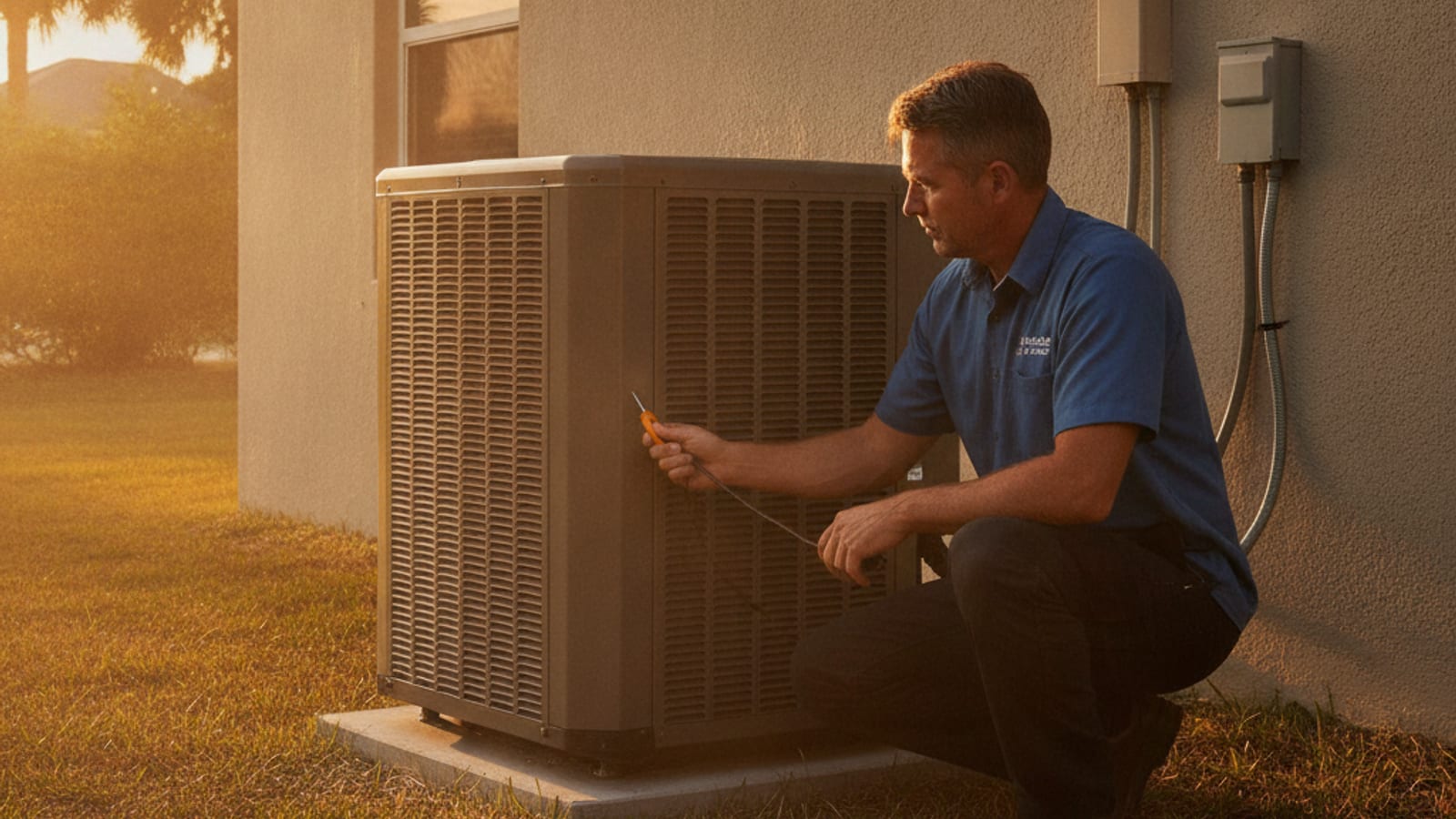
Your thermostat says 74. Your house feels like 80. If that gap sounds familiar, you’re not imagining it, and you’re not alone. Every June through September, Tampa Bay HVAC crews get flooded with the same call: the AC is running constantly and the house still feels damp and warm.
Florida cooling isn’t just a temperature problem. It’s a humidity problem wearing a temperature costume. A system that’s technically hitting its setpoint can still leave a house feeling clammy if it isn’t pulling moisture out of the air at the same time. Here’s what’s actually going on when your AC can’t keep up, and where the fix usually lives.
Humidity is doing more damage than the heat
Tampa’s cooling season runs nine months a year, and for most of it, outdoor humidity sits well above 70%. An air conditioner cools a house in two ways at once: it lowers the air temperature, and it condenses moisture out of the air as it passes over the cold evaporator coil. When either process falls behind, the house feels wrong even if the thermostat reads correctly.
A system that’s oversized for the space is the most common culprit. It blasts cold air fast, hits the setpoint, and shuts off before it’s run long enough to actually dehumidify. The house cools quickly but stays sticky, because short cooling cycles don’t give the coil time to wring the moisture out of the air. That clammy, “why does it feel worse than the thermostat says” sensation is almost always a sign of an oversizing or airflow issue, not a broken unit.
Refrigerant charge and coil condition
An AC system that’s low on refrigerant, whether from a slow leak or a bad install years ago, loses its ability to pull heat and moisture out of the air efficiently. The unit runs longer, the electric bill climbs, and the house still doesn’t feel right. Refrigerant doesn’t get “used up” in a sealed system, so if a unit is low, something is leaking somewhere in the lines or coil, and topping it off without finding the leak just means doing it again next season. What that repair runs is a separate question, and we work it through in our guide to AC refrigerant leak repair cost.
Dirty evaporator coils cause a similar problem from a different angle. A coil coated in dust and grime can’t transfer heat the way a clean one does, so the system works harder for less output. In homes near the Gulf or Tampa Bay itself, salt air speeds up corrosion on both the indoor coil and the outdoor condenser, which is one more reason coastal systems in Apollo Beach, St. Pete Beach, or Clearwater tend to need more frequent attention than units further inland in Brandon or Riverview.
Airflow blockages you might not notice
A dirty air filter is the simplest fix in HVAC and the one most often skipped. A filter that hasn’t been changed in months restricts airflow across the coil, which can cause it to freeze over entirely, at which point the system stops cooling altogether until the ice melts. Check filters monthly during peak season and swap them every 60 to 90 days, more often if you have pets or the house sits near a construction zone.
Closed vents, furniture blocking returns, and crushed or disconnected ductwork in the attic all choke airflow the same way. If certain rooms run warmer than others, especially upstairs rooms or additions built onto older homes, an airflow imbalance is a likely cause.
Aging systems from the Tampa building boom
A lot of Tampa Bay’s housing stock, especially neighborhoods built up through the 1978 to 1995 boom years in areas like Carrollwood, Town ‘N’ Country, and parts of Pinellas Park, is now carrying AC systems well past their expected service life. A 15-year-old unit wasn’t built to modern efficiency standards, and its ductwork was often sealed with materials that degrade over time. Add years of Florida heat cycling through attic ductwork that regularly hits 130 to 150 degrees, and leaks develop that pull hot, humid attic air straight into the supply side of the system.
If your AC is over 12 to 15 years old and repair costs keep climbing, it’s worth having a technician walk you through repair-versus-replace math rather than sinking more money into patchwork fixes. Sometimes the honest answer is one more repair. Sometimes it’s a new system that actually matches the house.
Capacitor and electrical failures
A failing run or start capacitor is one of the most common reasons an outdoor unit hums but the fan doesn’t spin, or the compressor short-cycles and trips the breaker. Capacitors wear out from heat and age, and Tampa’s summer heat accelerates that wear. Lightning strikes during Florida’s frequent summer thunderstorms can also damage control boards and capacitors outright, which is worth keeping in mind if your AC suddenly stops working right after a storm rolls through.
Condensate line clogs
Every AC system produces condensate as it pulls moisture from the air, and that water has to drain somewhere. Algae and debris build up in condensate lines over time, especially in Florida’s humid climate, and a clogged line will trip a safety switch that shuts the whole system down to prevent water damage. If your AC just stopped cooling with no warning and there’s water pooling near the indoor unit, a clogged condensate line is one of the first things worth checking before assuming the compressor failed.
Thermostat placement and wiring issues
A thermostat mounted in the wrong spot can make a perfectly healthy AC system look broken. If your thermostat sits in direct afternoon sun, near a supply vent that blows directly on it, or on a wall that shares space with a warm attic access point, it reads the local air temperature around itself rather than the true temperature of the room. That mismatch causes the system to shut off too early or run longer than it needs to, and homeowners often chase a phantom cooling problem for weeks before anyone checks thermostat placement.
Older thermostats with worn-out internal sensors or loose wiring connections can also misreport temperature entirely. If you’ve swapped in a smart thermostat recently and the cooling behavior changed noticeably, a wiring or configuration issue during that install is worth ruling out before assuming the AC unit itself failed.
Ductwork sized for a different system
Homes that have gone through an AC replacement without a full ductwork review sometimes end up with a mismatch between the new equipment and the old ducts. If a 3-ton system was swapped for a 4-ton system because a previous technician oversized the replacement, but the ductwork was originally sized and balanced for the smaller unit, the new system can push more air than the ducts are built to carry efficiently. That mismatch shows up as some rooms running strong and cold while others barely get airflow at all, even though the unit itself is functioning exactly as designed.
This is one more reason a full sizing review, not just an equipment swap, matters any time a system gets replaced. Ductwork sized for a different era, or a different tonnage, undermines even a brand-new, correctly rated unit.
Insulation and window issues outside the AC itself
Not every case of a struggling AC is actually about the AC. Attic insulation that has settled, compressed, or shifted over years leaves gaps that let heat radiate directly into living spaces below, particularly in homes built before more current insulation standards took hold. Single-pane windows or aging window seals let outside heat and humidity infiltrate rooms directly, forcing the AC to fight a constant, low-grade heat gain it was never sized to handle. In older homes throughout South Tampa and parts of St. Petersburg, upgrading insulation or resealing windows sometimes does more for comfort than any change to the AC system itself.
What to do before you call for repair
Start with the filter. Check the thermostat batteries and settings. Look at the outdoor unit and clear away any grass clippings, leaves, or debris that might be blocking airflow around the condenser. If the system is still short-cycling, running constantly without cooling, or leaving the house humid despite hitting the setpoint, it’s time to get a technician out to actually diagnose the issue instead of guessing.
We connect Tampa Bay homeowners with experienced, insured HVAC crews who diagnose the real cause rather than swapping parts and hoping. Whether it’s a refrigerant leak, a failing capacitor, or ductwork that’s been leaking hot attic air into your system for years, getting an accurate diagnosis is the difference between a fix that lasts and a repair bill that repeats every few months.
If your system is struggling to keep up this summer, start with AC repair to get a technician out for a real diagnosis, and ask about HVAC maintenance plans that catch these issues before they turn into a no-cool emergency during the hottest part of the year. A properly maintained system in Tampa Bay’s climate isn’t a luxury. It’s what keeps your house livable from May through October.