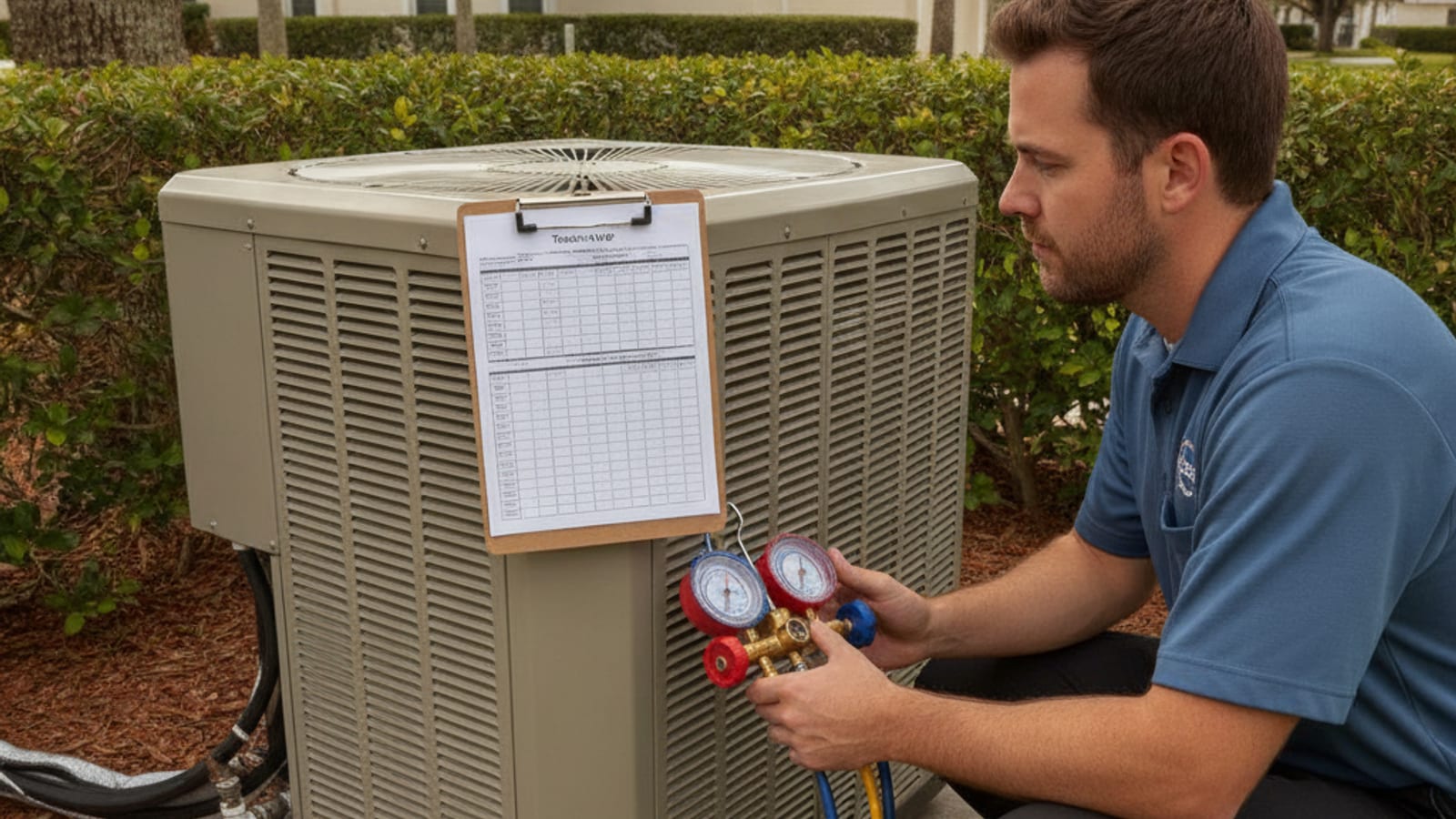
By late May, Tampa Bay’s cooling season is already three months old and the real test hasn’t even started. June through September is when a system either holds up or it doesn’t, and the systems that fail hardest in July are almost always the ones that skipped a spring tune-up. A 60-90 minute visit in May is a lot cheaper than an emergency call on a 96-degree Saturday in August.
Why Tampa’s cooling season is harder on equipment than most places
Most of the country runs AC seasonally, maybe four to five months a year. Tampa Bay runs it nine months, sometimes closer to year-round for anyone who dislikes humidity indoors. That means the compressor, the fan motors, and the refrigerant system get roughly double the run-hours of a system in Ohio or Colorado. More run-hours means more wear, more dust accumulation, and less margin for a small problem to go unnoticed before it becomes a breakdown.
A tune-up before the heaviest heat arrives, ideally April or May, catches the small stuff while it’s still cheap to fix.
What a real tune-up should include
Not all “tune-ups” are equal. Some companies run a 15-minute filter swap and call it done. Here’s what an actual, thorough pre-summer visit covers.
Refrigerant charge check
Low refrigerant is one of the most common causes of weak cooling and high electric bills, and it’s almost never obvious just by looking at the unit. A technician checks the system’s pressure against manufacturer specs and adjusts if needed. Low charge usually points to a slow leak somewhere in the line set or coil, worth flagging even if it’s not an emergency yet.
Coil cleaning, both indoor and outdoor
The outdoor condenser coil collects pollen, grass clippings, and in coastal areas, salt residue, all of which reduce the unit’s ability to shed heat. The indoor evaporator coil collects dust and, if humidity’s been an issue, can develop a light mold film. Both should be cleaned, not just visually inspected.
Electrical component inspection
Capacitors and contactors take a beating from Florida’s heat and humidity, and a weakening capacitor is one of the most common reasons a system won’t start on the first truly hot day even though it ran fine in April. A technician should test capacitor readings against spec rather than eyeballing it.
Condensate drain line clearing
Tampa Bay humidity means AC units pull a lot of water out of the air, and that water has to go somewhere. Algae and mold build up in condensate lines constantly in this climate, and a clogged line is one of the single most common causes of water damage and emergency calls in summer. This should be flushed every tune-up, not just checked.
Thermostat calibration and airflow check
A technician should confirm the thermostat is reading temperature accurately and check airflow at supply vents throughout the house. Weak airflow in specific rooms often points to duct issues that are easier to address before peak season than during it.
Fan motor and blower inspection
Both the outdoor fan motor and the indoor blower motor should be checked for unusual noise, wobble, or bearing wear. A motor that’s starting to fail often runs fine in mild weather but can’t keep up once the system is running near-constantly in July heat. If one is on its way out, our guide to blower motor replacement cost in Tampa Bay explains what the repair involves.
Filter replacement
The simplest item on the list and the one homeowners can do themselves between professional visits, but it’s worth confirming filter size and type are correct for your system during the tune-up, especially if you’ve recently switched to a higher-MERV filter that could be restricting airflow more than your system is designed to handle.
What a tune-up typically costs
A standard pre-summer ac tune-up for a Tampa Bay home usually runs $89-$189, depending on system size and whether it’s a stand-alone visit or part of an annual hvac maintenance plan. Many local companies offer a bundled twice-yearly plan, spring and fall, at a lower combined rate than two individual visits, and it also tends to guarantee priority scheduling during the peak-demand weeks in June and July when same-day appointments get harder to book.
Signs your system needs more than a tune-up
Sometimes a spring inspection turns up something bigger than routine wear. Watch for these signs that point toward repair rather than maintenance:
- The system is more than 12-15 years old and using an older refrigerant type
- Refrigerant levels are low year over year, suggesting an ongoing leak rather than a one-time top-off
- Electric bills have climbed steadily over the past two summers with no change in usage habits
- The compressor makes a hard clunking or grinding sound on startup
None of these mean panic, but they’re worth a real conversation with a technician about repair-versus-replace math before you’re stuck deciding it during a July heat wave.
Timing it right
April and May are the sweet spot. Demand is lower than peak summer, technicians have more flexible scheduling, and any issues found get fixed before they’re tested by 95-degree days. Waiting until June or July to schedule a tune-up means competing for appointments with everyone whose system just failed, and it means any problem the tune-up finds gets discovered under worse conditions, not better ones.
What DIY homeowners can reasonably check between visits
A professional tune-up shouldn’t be the only time your system gets attention between May and September. Homeowners can reasonably handle a few checks on their own between scheduled visits: swapping the filter every 30-60 days during peak season rather than the 90-day interval that’s fine in milder climates, keeping the outdoor unit clear of grass clippings, leaves, and overgrown landscaping within two feet on all sides, and confirming the condensate drain line near the air handler isn’t showing standing water or a musty smell that suggests a slow clog forming. None of this replaces the technical checks a technician performs, but it catches the kind of buildup that turns a minor issue into a bigger one between professional visits.
Why some tune-ups turn up nothing and that’s still worth it
Occasionally a homeowner books a spring tune-up and the technician finds the system in good shape with nothing to fix. That’s not a wasted visit. A clean bill of health confirmed in April means you’re not gambling on an unknown through the hardest months of the year, and it gives the technician a baseline reading, refrigerant pressure, capacitor values, amp draw, to compare against next year’s visit. Catching a gradual decline year over year is often easier than catching a sudden failure, and that comparison only works if someone’s been checking consistently.
How long does a typical AC tune-up take?
Most thorough tune-ups run 60-90 minutes for a standard residential system. A tune-up that’s done in 15-20 minutes is almost certainly skipping steps like coil cleaning or a full electrical component check, worth asking about directly if a visit feels rushed.
Can I skip the spring tune-up if I had one done in the fall?
It’s not ideal. Fall tune-ups typically focus more on catching issues before the milder winter months, while a spring visit is specifically timed to prepare the system for nine straight months of heavy cooling demand. The two visits check different wear patterns given how much running the system does between them.
What happens if a tune-up finds a refrigerant leak?
The technician should locate the leak source if possible, rather than just topping off the charge and sending you on your way. A top-off without addressing the leak means you’re likely back to low refrigerant within months, and repeated top-offs cost more over time than fixing the actual leak once.
The bottom line for Tampa Bay homeowners
A pre-summer tune-up isn’t a sales pitch, it’s the cheapest insurance available against a nine-month cooling season that doesn’t give equipment much room to rest. Catching a weak capacitor or a slow refrigerant leak in April costs a fraction of what an emergency compressor failure costs in August, and it means your family isn’t sweating out a holiday weekend waiting on a repair slot.
Call (813) 000-0000 and we’ll connect you with a licensed, insured local pro who can get your system checked and ready before the real heat sets in.